• The First Book: Spells and Drunkenness, Songs of Mayan Women

    This is the first book created, written, illustrated, printed and bound in paper of their own making, by indigenous Mayan people in nearly 500 years. This book is referred to as “Conjuros y ebriedades: cantos de mujeres mayas”, which translates to “Spells and drunkenness. Songs of Mayan women”. This book of Mayan artists is a collection of spells, hymns, and enchantments. It was originally written in the Tzotzil language, which is a Mayan dialect. The texts were later transcribed and translated by the poet Ambar Past, who said, “We get our ideas from the earth: we copy the fossil of a tropical leaf and the surface of a sea snail.” Elena Poniatowska says, “Conjuros y ebriedades is one of the hundred most beautiful books in the world. The cardboard face breathes, looks through the slits in its eyes, and speaks with its open mouth inside the paper.” One tremendous trait of the book is that if we hold the book in our hands, the eyes look at us. (Refer Image 1)
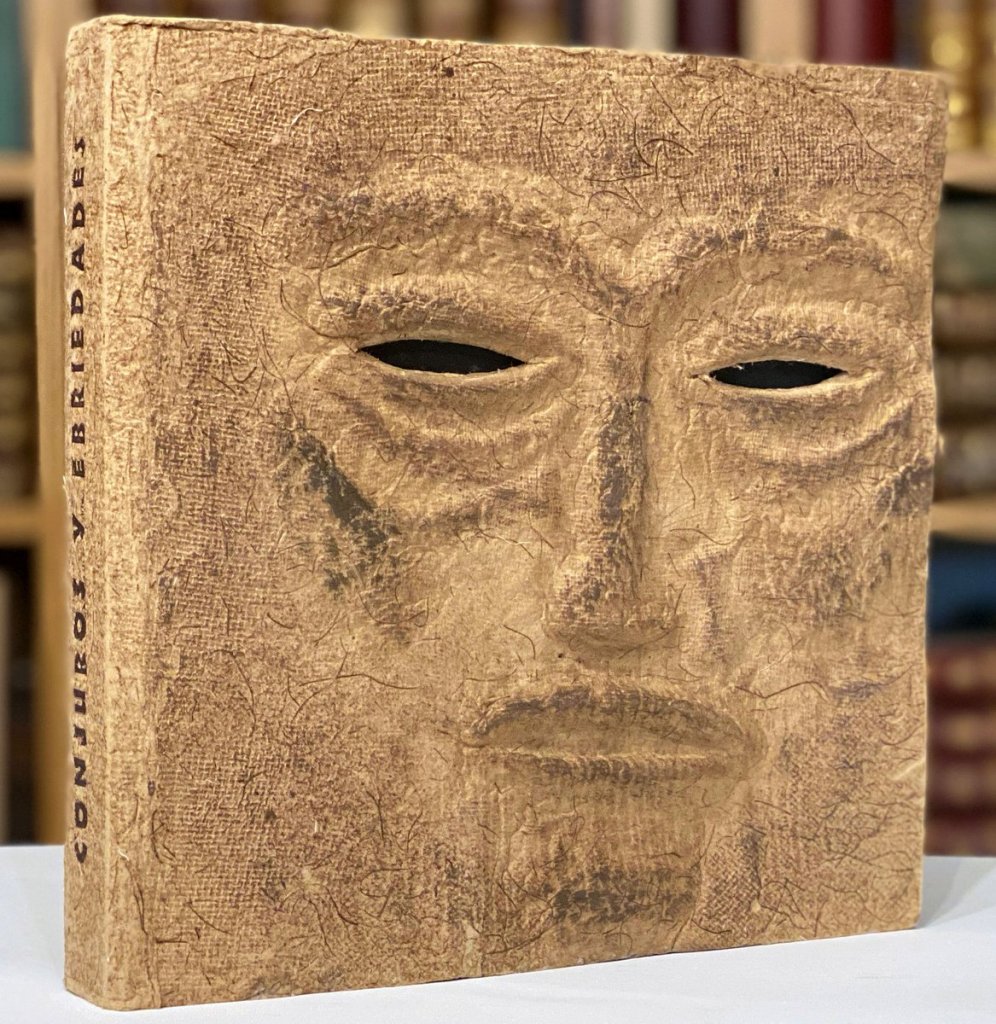
    Image 1

    The Taller Leñateros that publishes it, is a community of Mayan artists, founded in 1975 by the poet Ambar Past. His specialty is handmade paper, artist books, serigraphy and engraving (on wooden blocks and similar surfaces), pansey graphics, natural inks, etc. This book, 20 years in the making, records the traditional oral poetry of the local Tzotzil & Tzeltal people. (Refer Image 2).
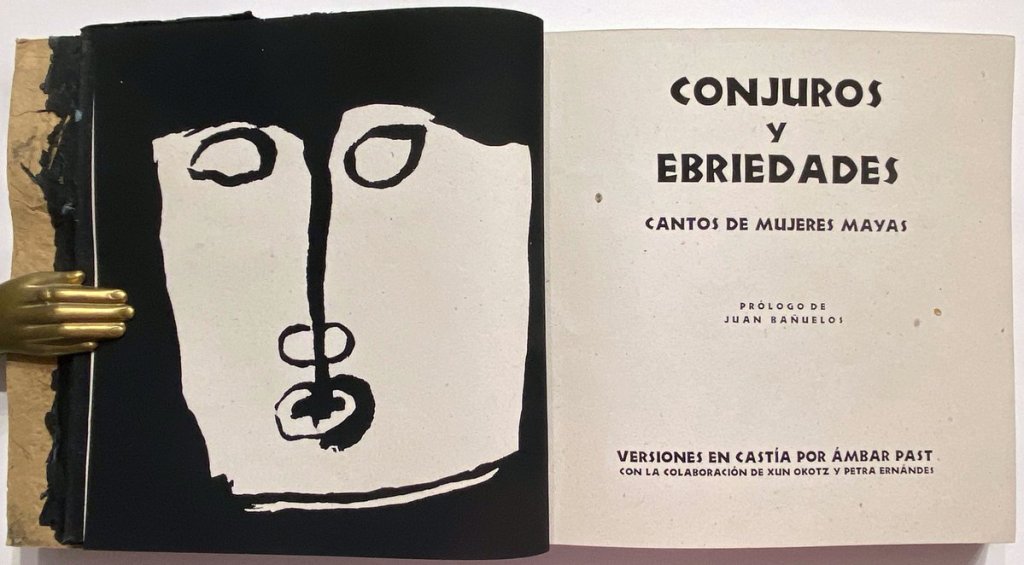
    Image 2

    The finished volume has 190 pages and 50 silkscreen illustrations by Tzotzil & Tzeltal women. The end papers are recycled paper with palm fronds, logwood and soot added. The three-dimensional cover is cast from paper made of recycled cardboard boxes, corn silk and coffee. Bound in boards covered with handmade brown paper, with a large face in relief representing the Mayan goddess of the desert filling the cover. The final pages are also handmade. Housed in a cardboard box printed with white title on the spine panel. It contains 45 poetic charms, 40 xerographed illustrations, among other various illustrations.
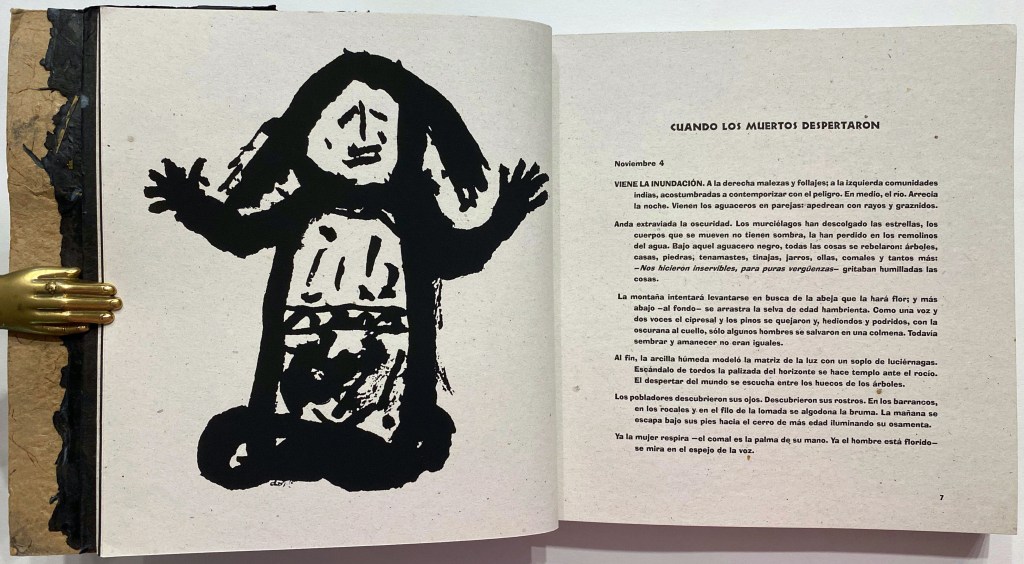
    Image 3

    The monologue is written in Spanish, while the poems are written in Tzotzil and have Spanish translations. About 400000 native Tzotzil Maya people in the Mexican state of Chiapas speak the Maya language Tzotzil. Most people who speak Spanish do so as a second language.
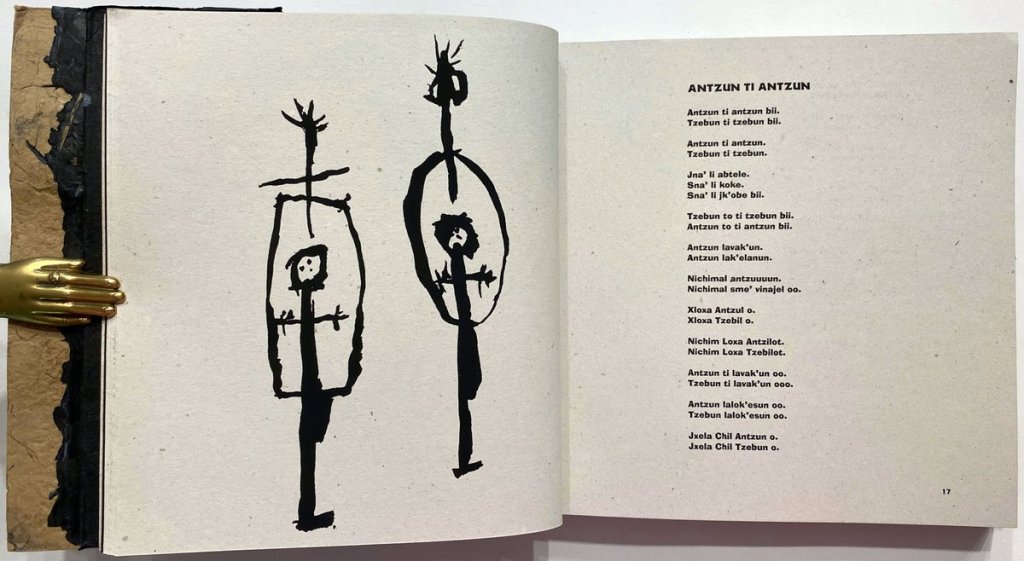
    Image 4

    Most moving of all  is the colophon, with the signature of Ámbar Past, and the signatures, personal marks & thumbprints of all the Mayan women – there are 150 in the collective – who assisted in the transcribing of the poems, and in the making of the book.
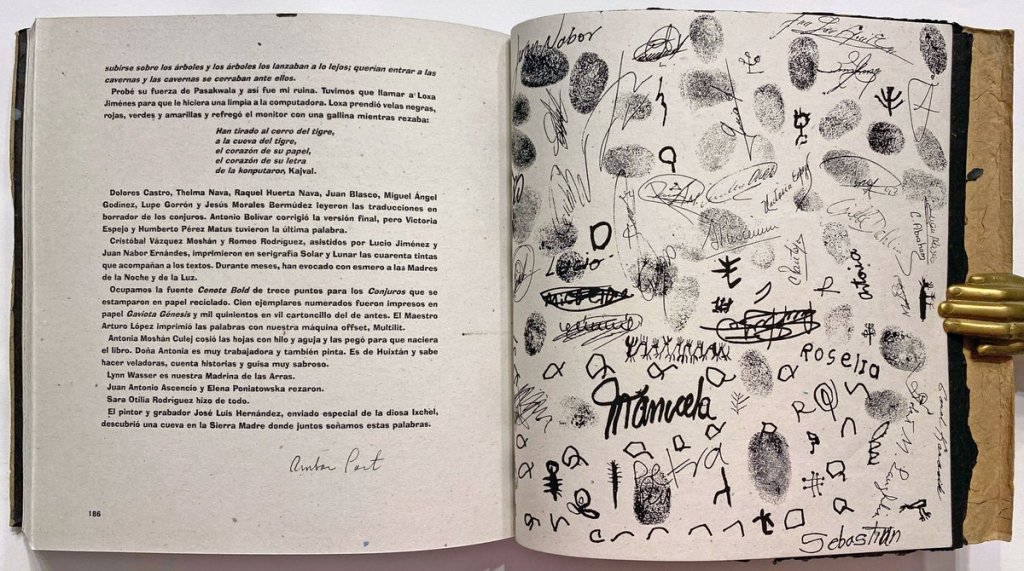
    Image 5

    In the words of Ambar Past,These spells and intoxicants were dreamed by Mayan women from the highlands of Chiapas. The Tzotzil authors of this book do not know how to read. They claim that these songs were given to them by their ancestors, the First Mothers, who keep the Great Book where they keep the spells. Loxa Jiménes Lópes, from Epal Ch’en, Chamula, says that an Anjel, daughter of the Owner of the Caves, began to speak in his ear and then in a dream showed him the Book with all the words of the songs”.

    Ambar Past

    *The rights to all images belongs to its owners.

    This article is researched and summarised by Aaditya Bajpai*
  • Art of a Centennial: A Repertory of Welsh Manuscripts and Scribes, Daniel Huws

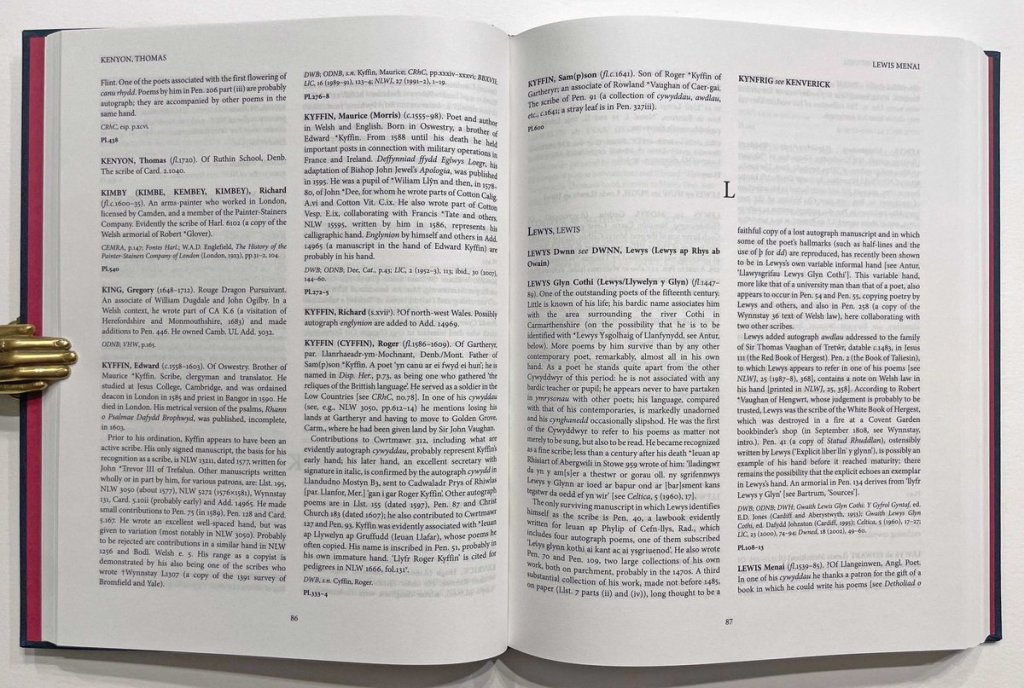
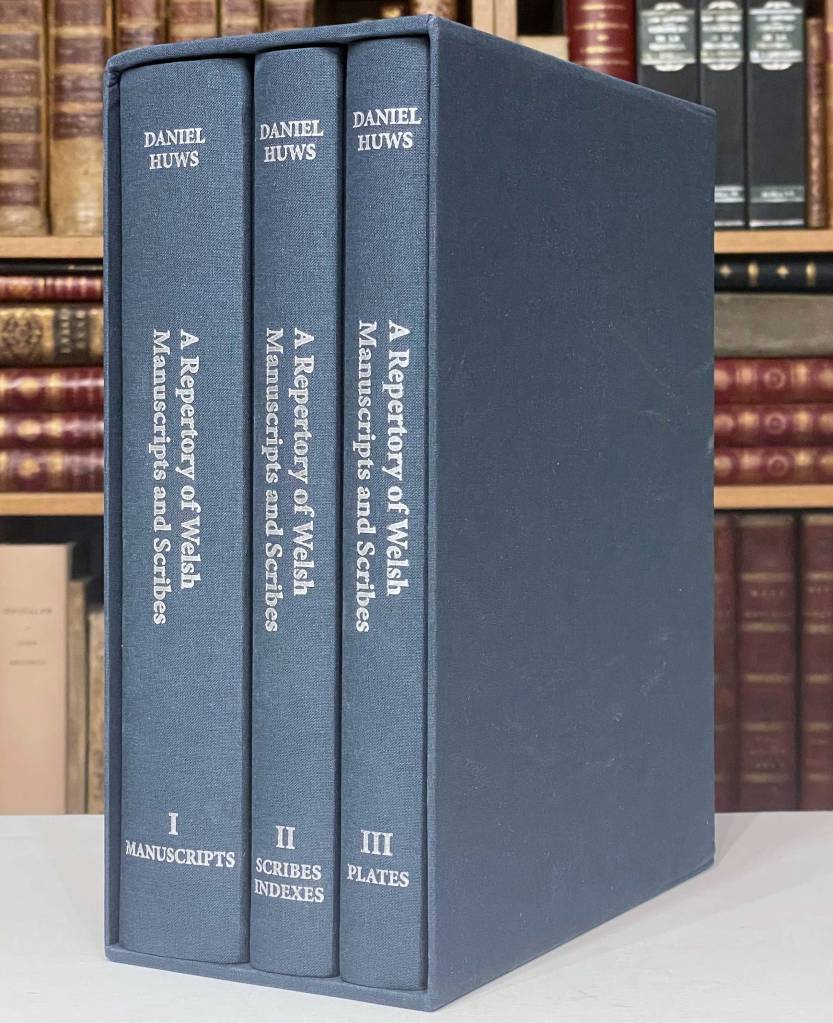
    It is not often that a reference book that is only produced once a Centennial is released, but “A Repertory of Welsh Manuscripts and Scribes c.800–c.1800” by Daniel Huws is precisely that kind of literature. The research into Welsh manuscripts will be completely transformed as a result of these three enormous volumes, the production of which took more than 25 years to complete. The author of the work is Dr. Daniel Huws, former Keeper of Manuscripts and Records at the Library and chief scholar of Welsh manuscripts.

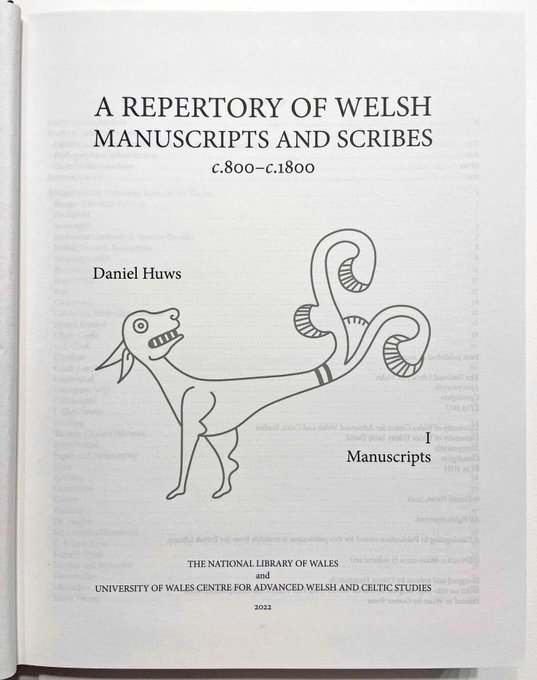
    The Three Volumes, A Repertory of Welsh Manuscripts and Scribes, Daniel Huws

    Volume 1

    From the earliest Welsh additions in the Lichfield Gospels to the publication of the Myvyrian Archaeology, the first volume of the Repertory provides summary descriptions of approximately 3,300 manuscripts written in Welsh between approximately the centuries 800 and 1800. This includes manuscripts written in other languages that relate to Welsh literature and learning.

    Manuscripts were the primary mode of transmission of the greater part of Welsh literature until the appearance of the Myvyrian. The Repertory embraces manuscripts written in Welsh, whether literary or relating to the branches of learning in which there was Welsh tradition: cosmology, genealogy, history, religion, law, science, medicine; manuscripts of Welsh provenance containing cognate texts written in Latin and English are also included.

    With regards to the contents of manuscripts, the Repertory aims to supplement but not to supersede previous detailed catalogues, most notably the masterly work of J. Gwenogvryn Evans in his Reports on Manuscripts in the Welsh Language (1898-1910), where some 900 manuscripts are catalogued. Besides its aim of providing reference to later scholarship, the Repertory offers much that is new with respect to the structure of manuscripts, their script, their dates, their textual relationships and provenance, and, above all, to identification of their scribes. The volume is arranged, firstly, by location (Aberystwyth-Warwick), then by library or record repository, and then by collection or class. The major collections are introduced by an account of their growth and later history.

    The Cover of Volume 1

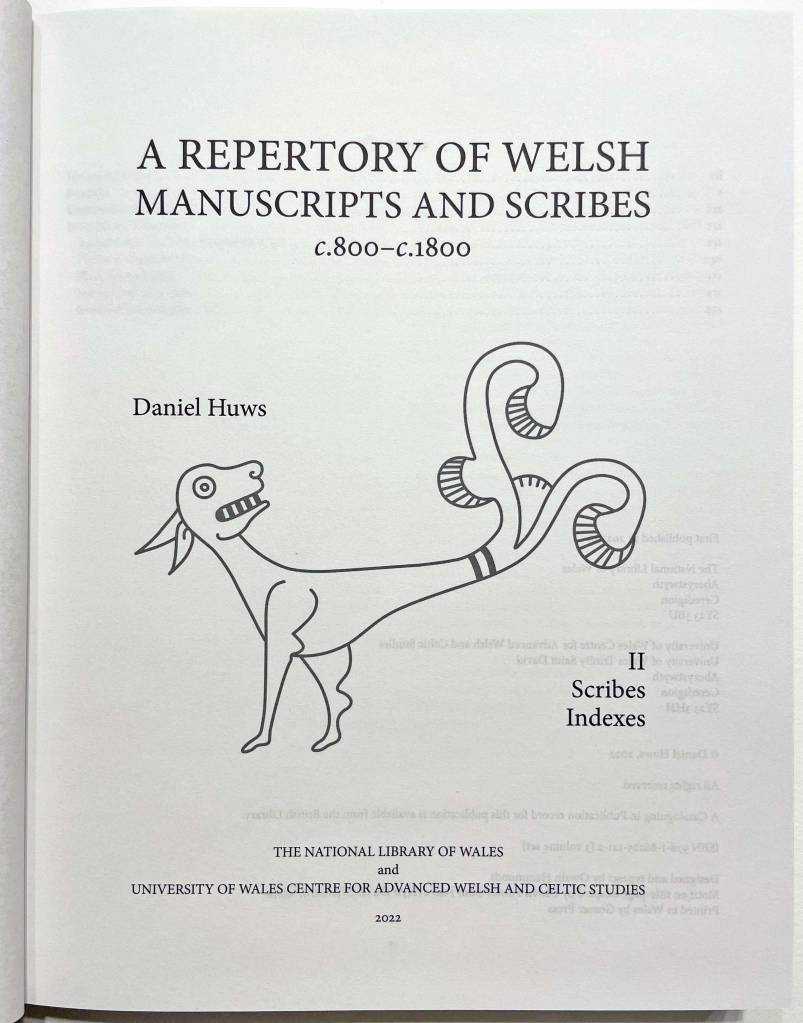
    Volume 2

    The second volume of the Repertory offers in the first place summary accounts of about 1,500 scribes known by name and anonymous ones whose hands have been recognized in two or more manuscripts, designated XI-X180. skeleton of biographical data is provided, so far as possible, for each scribe, including much new information from manuscript and archival sources.

    The scribes’ interests and scribal activities are characterized; manuscripts contributed to are listed, as are any owned or otherwise associated with the scribe. Hundreds of hitherto unknown scribes worthy of study will emerge from the Repertory. But hardly any of the best known scribes will emerge without receiving credit for new manuscripts. Authors as well-studied as Lewys Glyn Cothi, William Salesbury and John Prise now have revealing new manuscripts to their names.

    We can now for the first time read poems by Tudur Aled, Roger Kyffin and Rhys Cadwaladr knowing them to be autograph. Recognition of the handwriting of scholars as notable as Maurice Kyffin, David Powel, Nicholas Robinson and Robert Davies of Gwysaney will lead to overdue appreciation of their important historical compilations. Vol. II also includes the indexes to Vol. I. These occupy 250 pages and comprise an index of personal names, an index of place-names, an index of subjects and texts and a chronological table of manuscripts to 1547. The subject index will be of particular value in relation to the history of the book trade, with its comprehensive gathering of references to libraries and catalogues, auctions and sales.

    The Cover of Volume 2

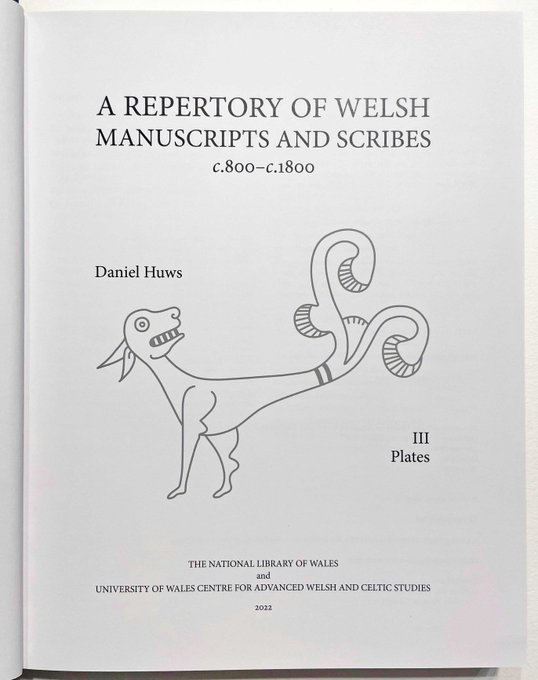
    Volume 3

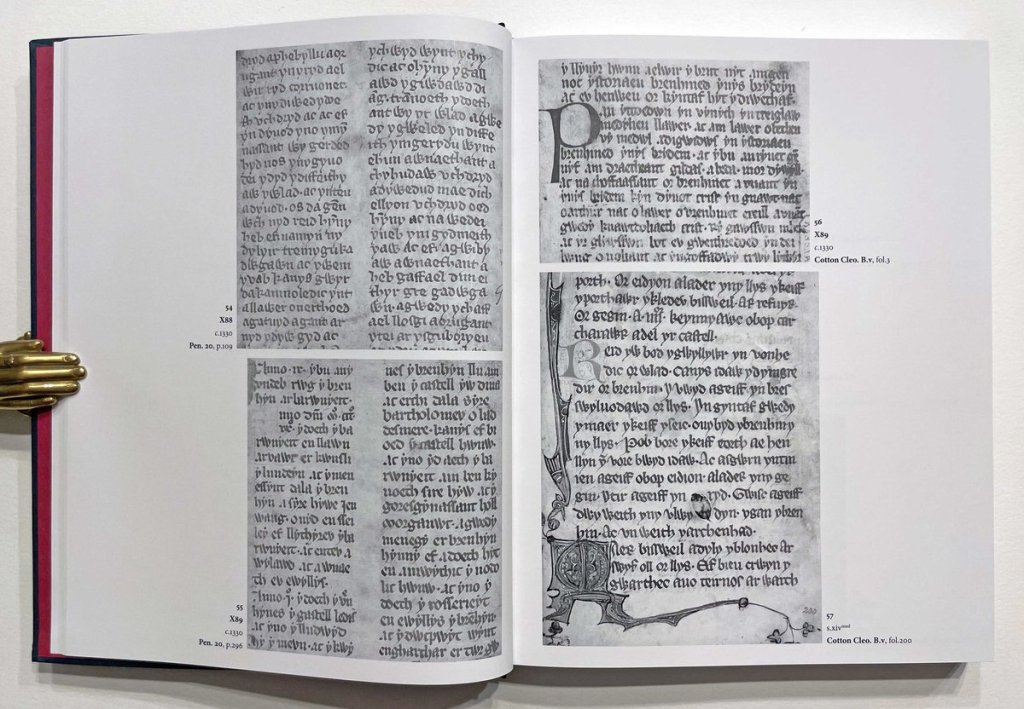
    A volume offering over 1,000 specimens, all reproduced to their actual size, of the scripts of about 750 of the most significant scribes included in Vol. I, along with a selection of scribes (mostly medieval) of the highest importance whose hands only appear in a single manuscript. Most scribes are represented by a single specimen; however, scribes such as John Jones of Gellilyfdy and Robert Vaughan of Hengwrt who practised a variety of scripts and scribes whose hands changed markedly over the years may be represented by as many as nine.

    Examples that represent a number of scribes are included in this volume by virtue of their being somewhere on the scale that ranges from probably’ to possibly. Those that, for instance, represent Dafydd ap Gwilym, Gruffudd Gryg and Dafydd ab Edmwnd stand to be challenged. Much care has been taken to try so far as possible to find examples that are dated or datable and examples that include a signature. This volume will be of abiding value to palaeographers, also no doubt to collectors of early books.

    This volume may become a place of frequent resort as an album of the autographs of a host of famous writers of Wales, from Rhygyfarch ap Sulien to Jac Glan-y-gors, from John Wynn of Gwydir to Iolo Morganwg. Readers will be able to wonder at the calligraphic skills of leuan Llwyd ab Edward and George Owen Harry, and the many who cannot resist the urge to read character into a person’s handwriting will find endless edification.

    The Cover of Volume 3

    Conclusion

    It’s safe to say that nothing of comparable importance on Welsh manuscripts will be published in our lifetime. Daniel Huws’s Repertory is a milestone in Welsh scholarship, and will be a fundamental resource in the study of Welsh history, language, literature & palaeography.

    The Repertory is not available – at least not yet – from any booksellers I know, and cannot be ordered online. You need to order Daniel Huw’s magnum opus by phone or email direct from the National Library of Wales in Aberystwyth, details here: https://library.wales/repertory.

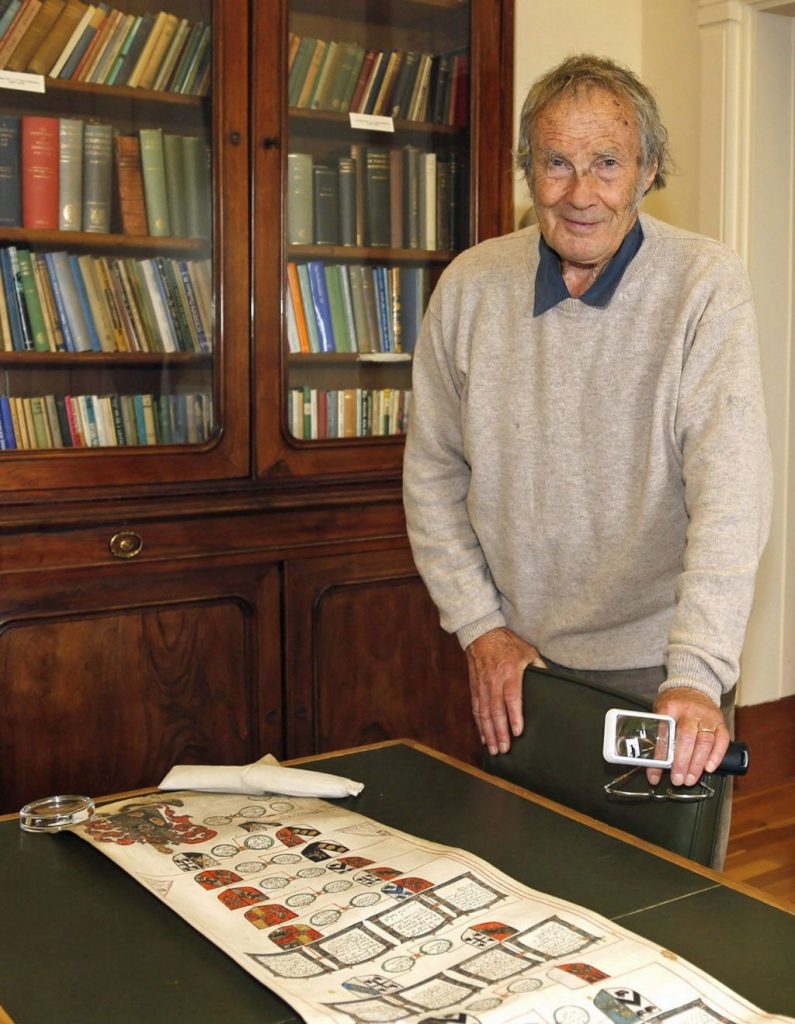
    Dr. Daniel Huws
  • Amber

    looking at your hairs
    coming on your face
    in this beautiful september.
    i keep falling for you
    for you are beautiful
    and your eyes, amber.
    aaditya
  • Nothing

    My love for you still whispers,
    hoping that someday, it shall be heard.
    And now, when it’s all said and done;
    grief is the price that we pay for love.
    (nothing, lines 27-30, aaditya bajpai)
  • Yearn

    Stars faded away, and even
    the wind was mourning that night.
    The elements of the universe, too
    cried, when you went out of my sight.
    Seeing me yearn for you, even
    the moon bled in my plight.
    -aaditya
  • Red

    You’re the love that I feel, and
    you’re the feeling that I love.
    You’re the light, lighting my flames,
    and you’re the Red, in my veins.
    You’re the poetry in my heart,
    in hope and in times of distress;
    and you’re the syaahi to my art,
    and the answer to all my requests.

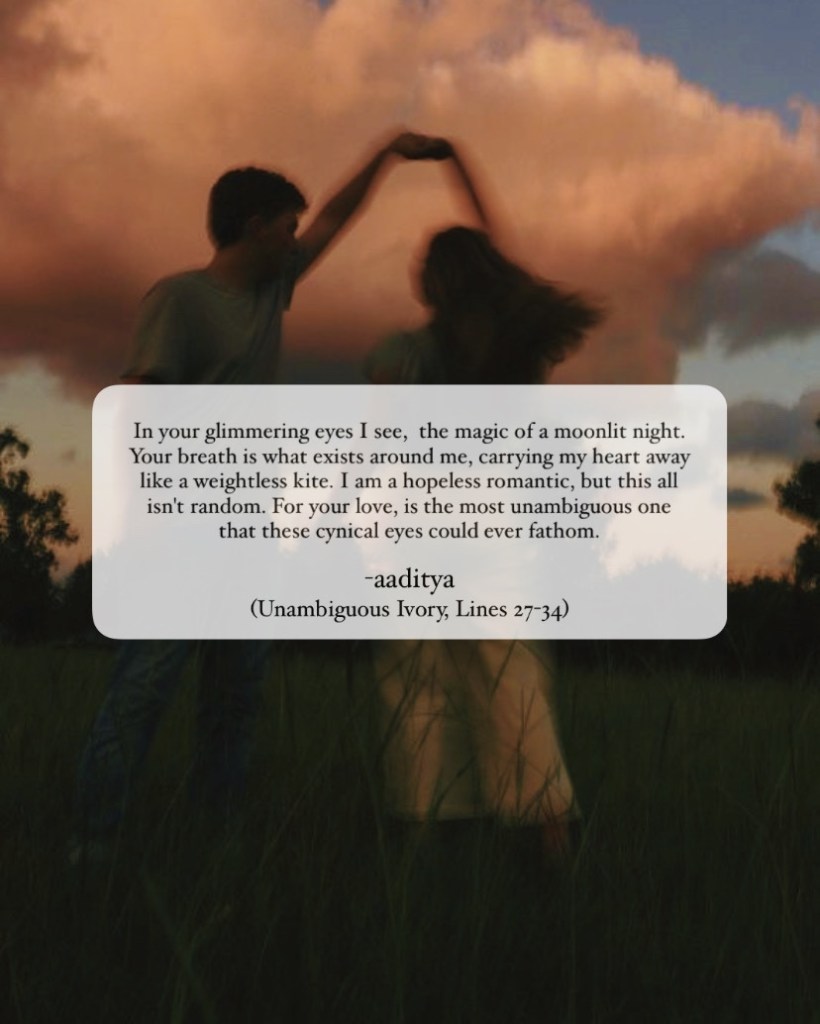
    (Red, Lines 17-24, Aaditya Bajpai)
  • Butterflies

    I see me in you, with you, and for you.
    You’re the chaos in my mind,
    and in your love, I sink.
    You’re the poem in my heart,
    and my love for you is the ink.
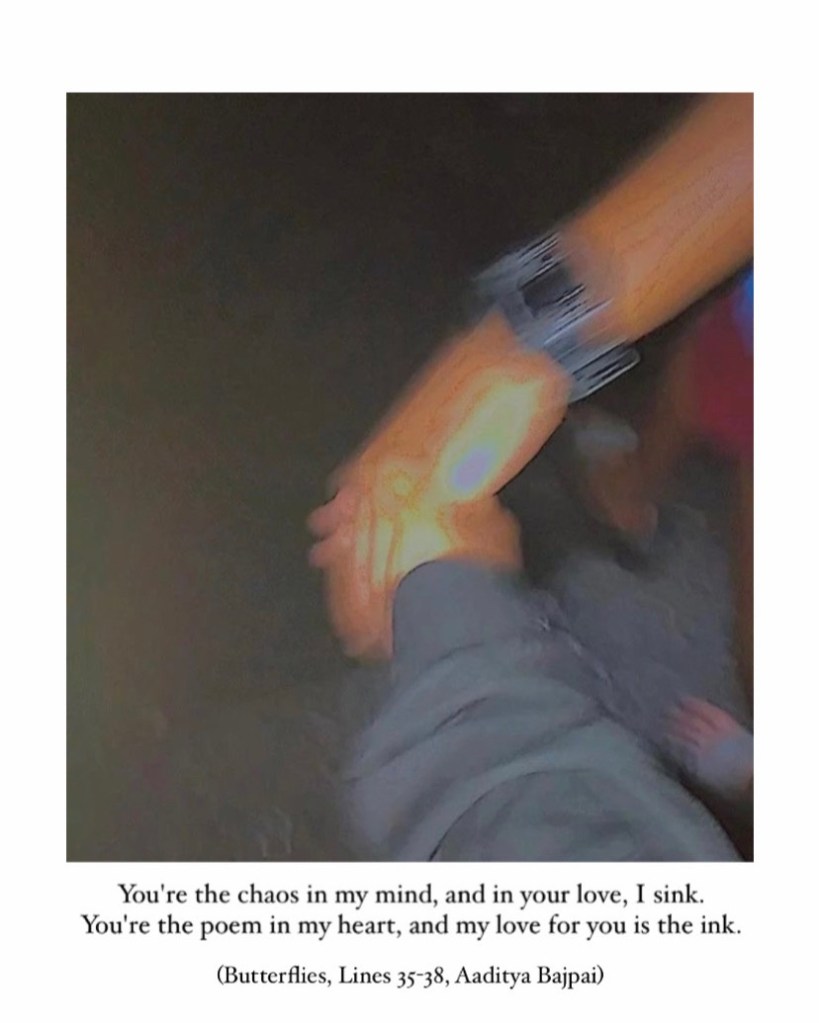
    (Butterflies, Lines 35-38, Aaditya Bajpai)
  • Polaroid

    With the moon sneaking up
    from the ocean at night,
    I remember you.
    That Polaroid photo of ours
    still hanging on the wall of
    my bedroom, and in it, me
    kissing you by the beach,
    and finding solace in you.
    (Poem – Polaroid, Lines 53-60, Aaditya Bajpai)

    all rights reserved

Design a site like this with WordPress.com
Get started