
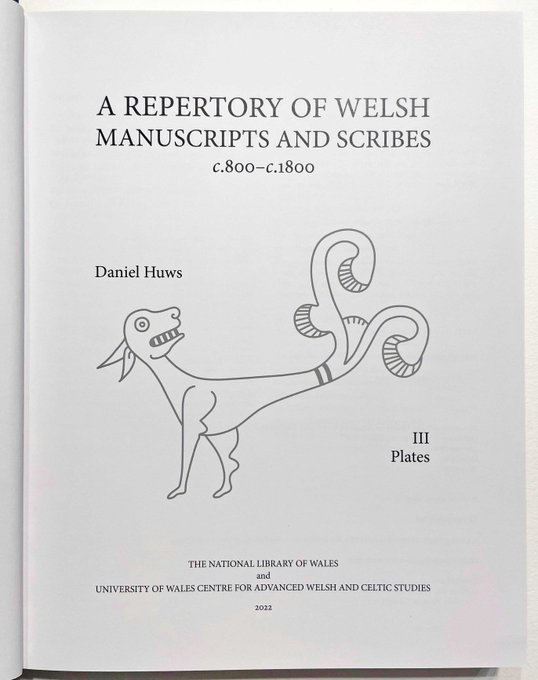
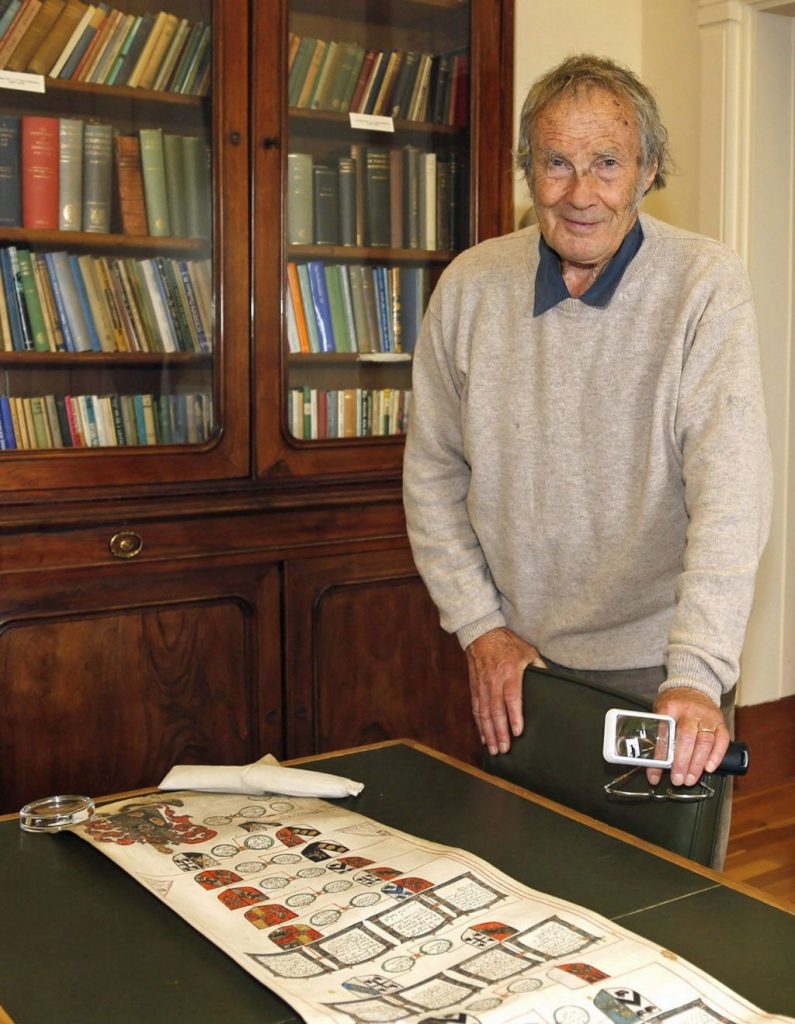
It is not often that a reference book that is only produced once a Centennial is released, but “A Repertory of Welsh Manuscripts and Scribes c.800–c.1800” by Daniel Huws is precisely that kind of literature. The research into Welsh manuscripts will be completely transformed as a result of these three enormous volumes, the production of which took more than 25 years to complete. The author of the work is Dr. Daniel Huws, former Keeper of Manuscripts and Records at the Library and chief scholar of Welsh manuscripts.
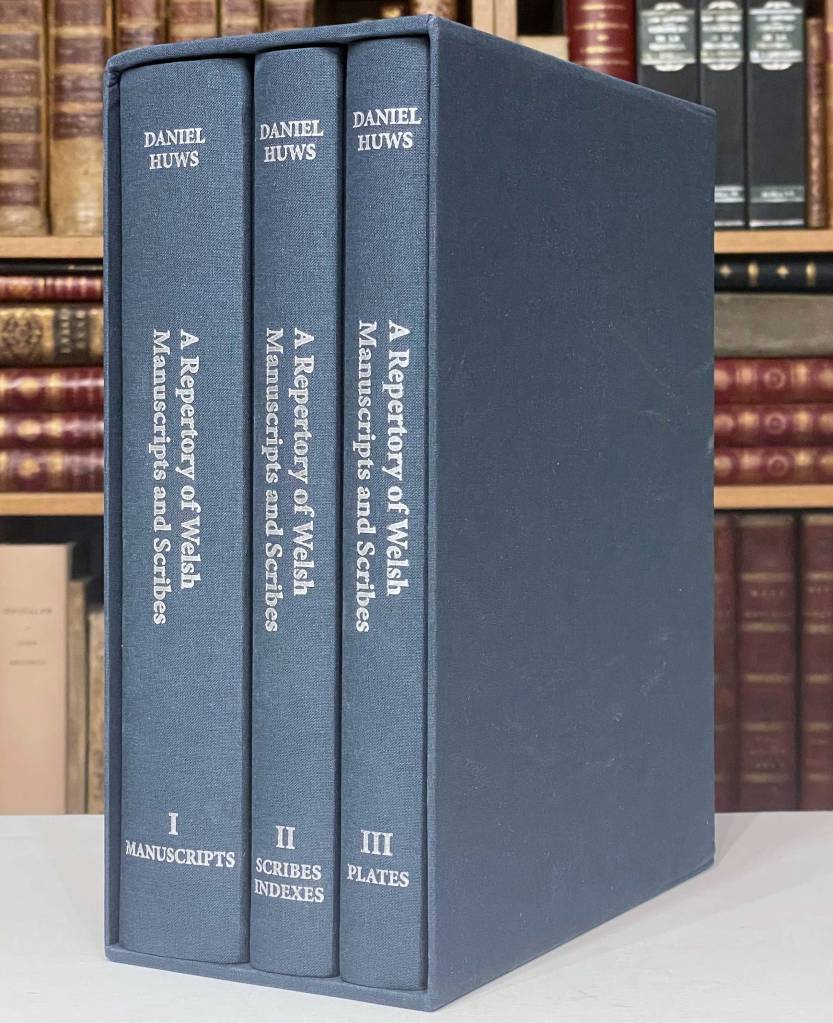
Volume 1
From the earliest Welsh additions in the Lichfield Gospels to the publication of the Myvyrian Archaeology, the first volume of the Repertory provides summary descriptions of approximately 3,300 manuscripts written in Welsh between approximately the centuries 800 and 1800. This includes manuscripts written in other languages that relate to Welsh literature and learning.
Manuscripts were the primary mode of transmission of the greater part of Welsh literature until the appearance of the Myvyrian. The Repertory embraces manuscripts written in Welsh, whether literary or relating to the branches of learning in which there was Welsh tradition: cosmology, genealogy, history, religion, law, science, medicine; manuscripts of Welsh provenance containing cognate texts written in Latin and English are also included.
With regards to the contents of manuscripts, the Repertory aims to supplement but not to supersede previous detailed catalogues, most notably the masterly work of J. Gwenogvryn Evans in his Reports on Manuscripts in the Welsh Language (1898-1910), where some 900 manuscripts are catalogued. Besides its aim of providing reference to later scholarship, the Repertory offers much that is new with respect to the structure of manuscripts, their script, their dates, their textual relationships and provenance, and, above all, to identification of their scribes. The volume is arranged, firstly, by location (Aberystwyth-Warwick), then by library or record repository, and then by collection or class. The major collections are introduced by an account of their growth and later history.
Volume 2
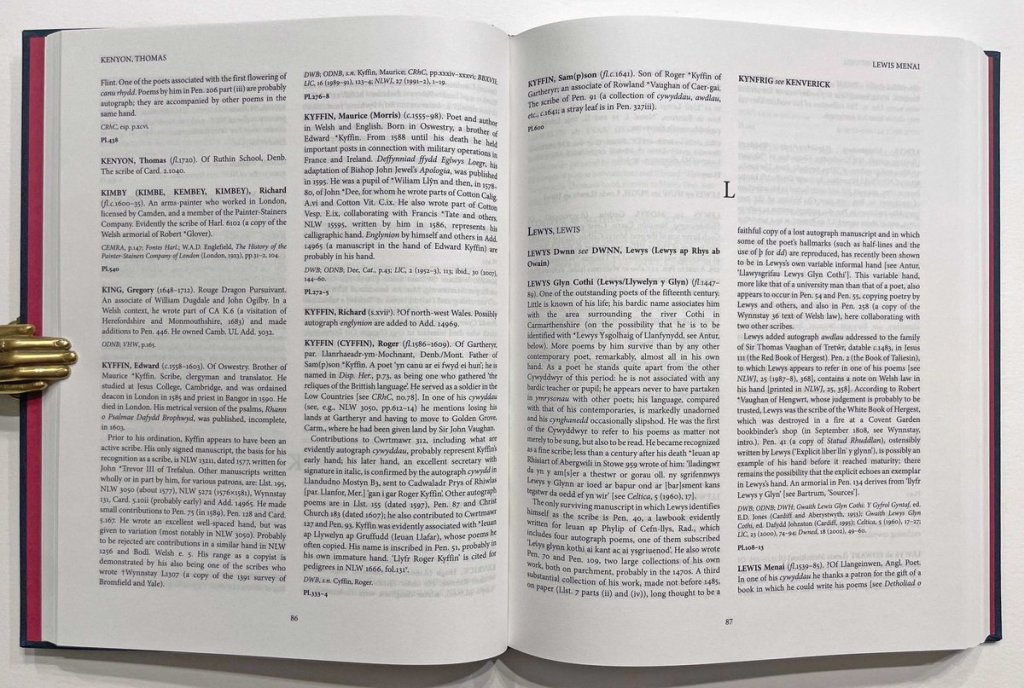
The second volume of the Repertory offers in the first place summary accounts of about 1,500 scribes known by name and anonymous ones whose hands have been recognized in two or more manuscripts, designated XI-X180. skeleton of biographical data is provided, so far as possible, for each scribe, including much new information from manuscript and archival sources.
The scribes’ interests and scribal activities are characterized; manuscripts contributed to are listed, as are any owned or otherwise associated with the scribe. Hundreds of hitherto unknown scribes worthy of study will emerge from the Repertory. But hardly any of the best known scribes will emerge without receiving credit for new manuscripts. Authors as well-studied as Lewys Glyn Cothi, William Salesbury and John Prise now have revealing new manuscripts to their names.
We can now for the first time read poems by Tudur Aled, Roger Kyffin and Rhys Cadwaladr knowing them to be autograph. Recognition of the handwriting of scholars as notable as Maurice Kyffin, David Powel, Nicholas Robinson and Robert Davies of Gwysaney will lead to overdue appreciation of their important historical compilations. Vol. II also includes the indexes to Vol. I. These occupy 250 pages and comprise an index of personal names, an index of place-names, an index of subjects and texts and a chronological table of manuscripts to 1547. The subject index will be of particular value in relation to the history of the book trade, with its comprehensive gathering of references to libraries and catalogues, auctions and sales.
Volume 3
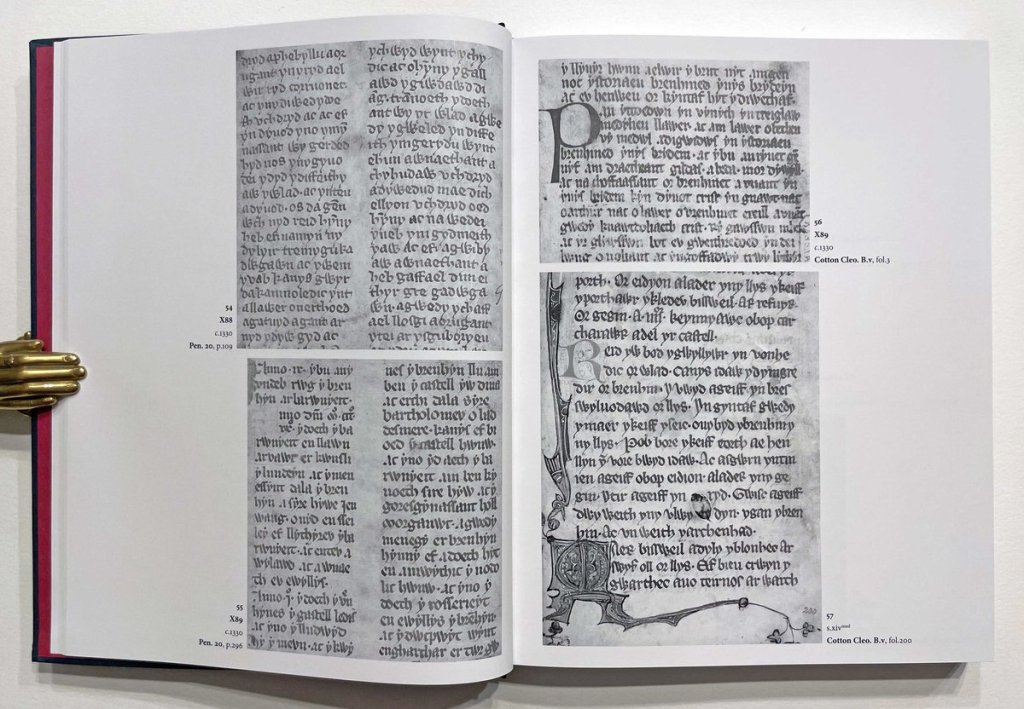
A volume offering over 1,000 specimens, all reproduced to their actual size, of the scripts of about 750 of the most significant scribes included in Vol. I, along with a selection of scribes (mostly medieval) of the highest importance whose hands only appear in a single manuscript. Most scribes are represented by a single specimen; however, scribes such as John Jones of Gellilyfdy and Robert Vaughan of Hengwrt who practised a variety of scripts and scribes whose hands changed markedly over the years may be represented by as many as nine.
Examples that represent a number of scribes are included in this volume by virtue of their being somewhere on the scale that ranges from probably’ to possibly. Those that, for instance, represent Dafydd ap Gwilym, Gruffudd Gryg and Dafydd ab Edmwnd stand to be challenged. Much care has been taken to try so far as possible to find examples that are dated or datable and examples that include a signature. This volume will be of abiding value to palaeographers, also no doubt to collectors of early books.
This volume may become a place of frequent resort as an album of the autographs of a host of famous writers of Wales, from Rhygyfarch ap Sulien to Jac Glan-y-gors, from John Wynn of Gwydir to Iolo Morganwg. Readers will be able to wonder at the calligraphic skills of leuan Llwyd ab Edward and George Owen Harry, and the many who cannot resist the urge to read character into a person’s handwriting will find endless edification.
Conclusion
It’s safe to say that nothing of comparable importance on Welsh manuscripts will be published in our lifetime. Daniel Huws’s Repertory is a milestone in Welsh scholarship, and will be a fundamental resource in the study of Welsh history, language, literature & palaeography.
The Repertory is not available – at least not yet – from any booksellers I know, and cannot be ordered online. You need to order Daniel Huw’s magnum opus by phone or email direct from the National Library of Wales in Aberystwyth, details here: https://library.wales/repertory.









 Aaditya Bajpai