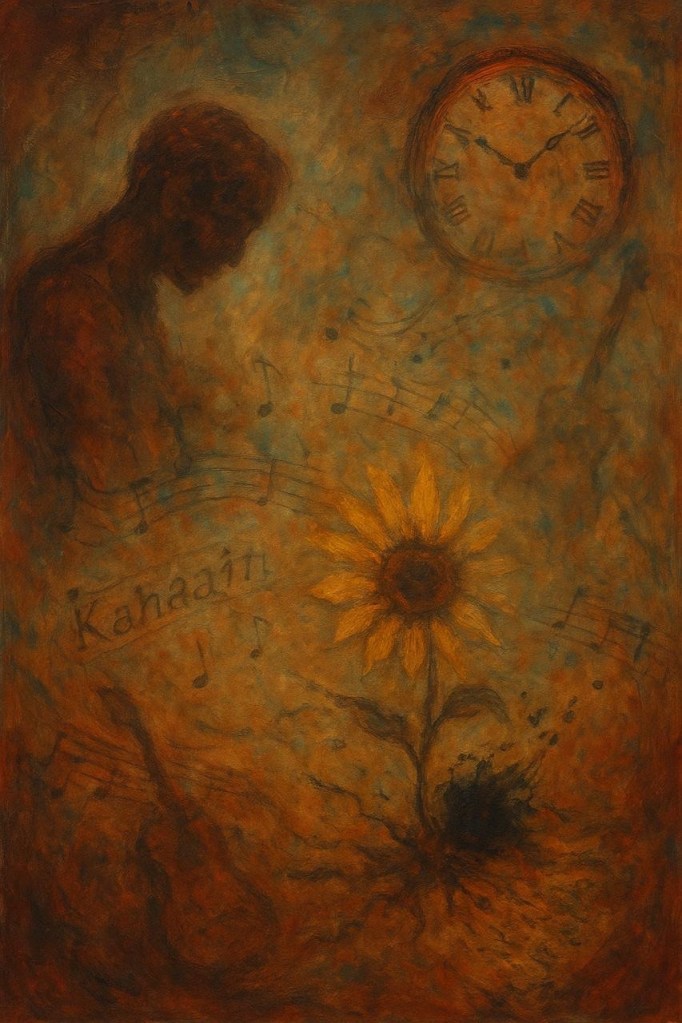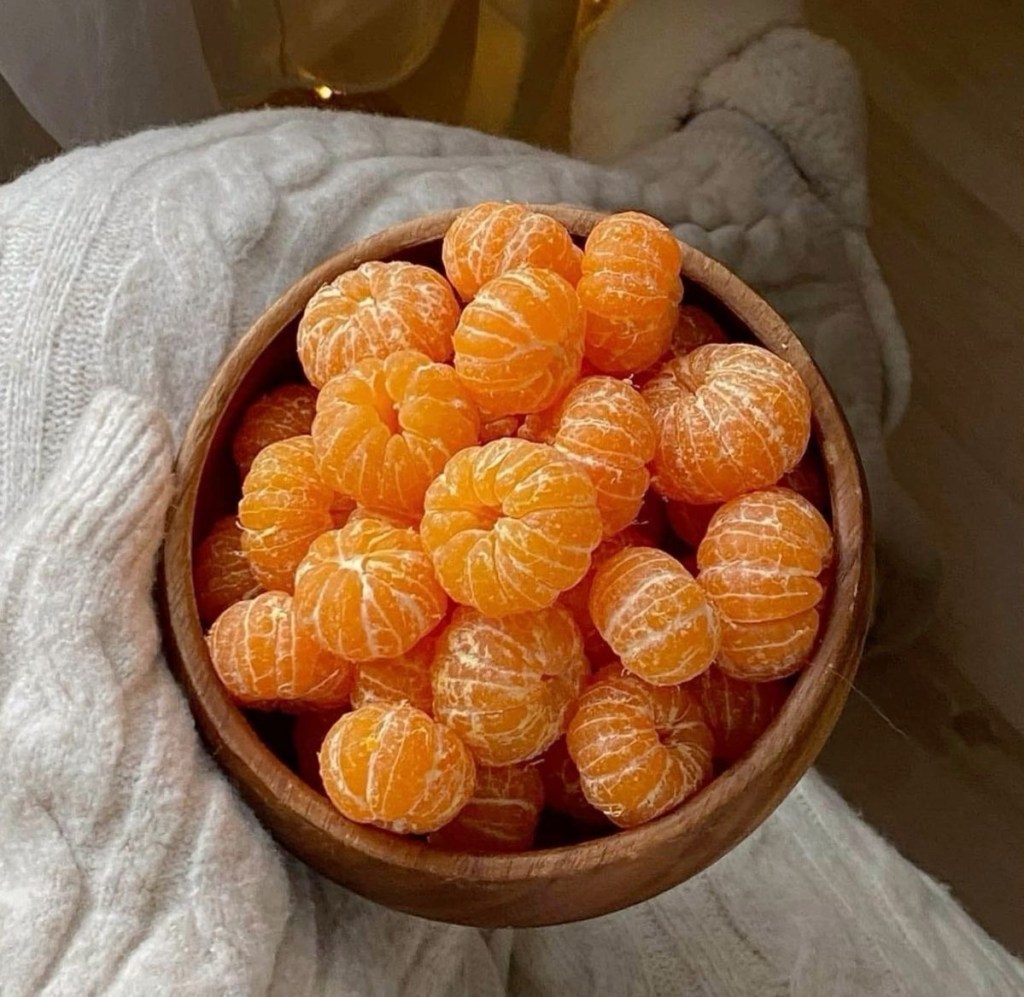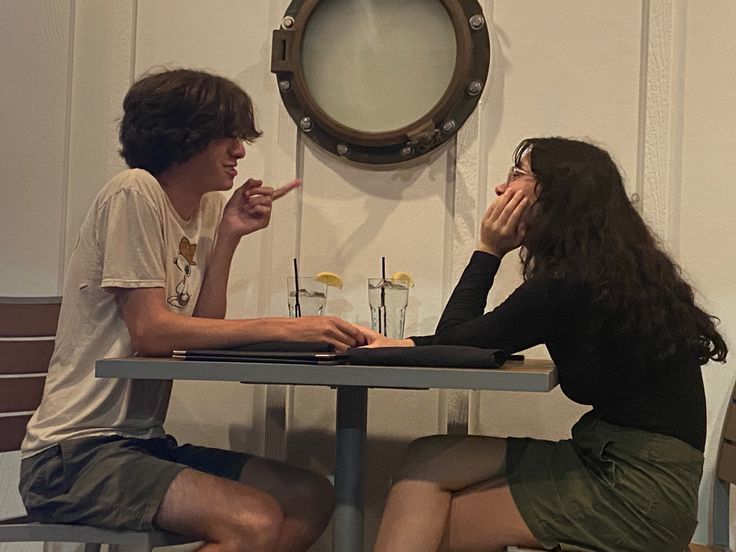
December stands still, yet moves within itself, a solemn breath before the year exhales. The air whispers secrets of frost and fire, a quiet warmth nestled in the heart of cold.
Beneath bare trees, life lingers, fragile as the glass ornaments we cradle, shining and trembling, aware of their fragility.
It is the month of hands— hands to hold close, hands to wave goodbye. Snow falls like memory, each flake a piece of what was, melting as it lands.
The sky wears both dawn and dusk together, an endless twilight where time folds in on itself. The past feels closer, the future a breath you cannot catch.
Love in December is fierce, burning against the chill, because it knows it must. Because it knows it will soon have to let go.
And so, we wrap the year in ribbons, in the ache of holding on, in the grace of release. December, you are the stillness of endings, the weight of beginnings, a lesson in everything we can never quite keep.
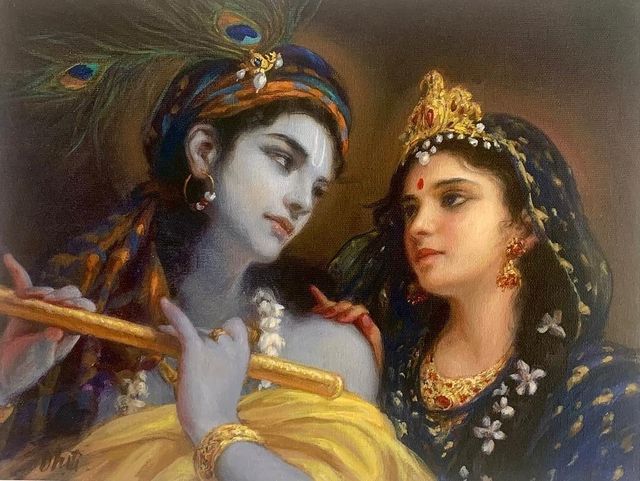
“O woman with desire, place on this patch of flower-strewn floor your lotus foot, And let your foot through beauty win, To me who am the Lord of All, O be attached, now always yours”
Krishna to Radha
When Krishna left for Mathura, the mind of Srimati Radharani was completely disrupted. She became almost mad because of the extreme separation from Krishna and experienced great mental pain and agitation, which caused Her to drown in various sorts of mental speculation in the river of anxiety.
She (Radharani) thought, ‘Now I am going to die, and when I die, Kṛṣṇa will surely come back to see Me again. But when He hears of My death from the people of Vṛndāvana, He will certainly be very unhappy. Therefore I shall not die.’
luṭhati ca bhuvi rādhā kampitāṅgī murāre viṣama-viraha-khedodgāri-vibhrānta-cittā
Uddhava said to Lord Kṛṣṇa, “My dear Kṛṣṇa, all the gopīs are so afflicted by Your absence that they have become almost mad. O Murāri, at home Śrīmatī Rādhārāṇī laughs unnecessarily and, like a madwoman, inquires about You from every entity without distinction, even from the stones. She rolls on the ground, unable to bear the agony of Your absence.” – Sri Ujjvala Nilamani 15.175
Radharani would madly talk (Pralāpa) as follows
kva nanda-kula-candramāḥ kva śikhi-candra-kālaṅkṛtiḥ kva mandra-muralī-ravaḥ kva nu surendra-nīla-dyutiḥ kva rāsa-rasa-tāṇḍavī kva sakhi jīva-rakṣauṣadhir nidhir mama suhṛttamaḥ kva tava hanta hā dhig vidhiḥ
My dear friend, where is Kṛṣṇa, who is like the moon rising from the ocean of Mahārāja Nanda’s dynasty? Where is Kṛṣṇa, His head decorated with a peacock feather? Where is He? Where is Kṛṣṇa, whose flute produces such a deep sound? Oh, where is Kṛṣṇa, whose bodily luster is like the luster of the blue indranīla jewel? Where is Kṛṣṇa, who is so expert in rāsa dancing? Oh, where is He, who can save My life? Kindly tell Me where to find Kṛṣṇa, the treasure of My life and best of My friends. Feeling separation from Him, I hereby condemn Providence, the shaper of My destiny.-Lalita-Madhava 3.25
Radharani won’t eat anything. Even sleep would desert Her. Thus, She had become very thin (Tānava). Uddhava thus describes Her condition to Krishna as follows
Consider the condition of the gopīs! Śrīmatī Rādhārāṇī especially is in a very painful condition because of separation from You. She has grown skinny, and Her bodily lustre is almost gone. Her heart is immersed in pain, and because She has given up eating, Her breasts have become black, as if diseased. Because of separation from You, all the gopīs, especially Rādhārāṇī, appear like dried-up water holes under the scorching heat of the sun. -Sri Ujjvala Nilamani 15.171
Observing the death-like condition of Srimati Radharani, Lalita Sakhi, wrote a strong letter to Krishna and chastised Him for staying in Mathura. She thus wrote as follows
aye rāsa-krīḍā-rasika mama sakhyaṁ nava-navā purā baddhā yena praṇaya-laharī hanta gahanā sa cen muktāpekṣas tvam asi dhig imāṁ tūla-śakalaṁ yad etasyā nāsā-nihitam idam adyāpi calati
Simply by dancing in the circle of the rāsa dance, You attracted Śrīmatī Rādhārāṇī’s love. Why are You now so indifferent to my dear friend Rādhārāṇī? She is lying nearly unconscious, thinking of Your pastimes. I shall determine whether She is alive by putting a cotton swab under Her nostrils, and if She is still living, I shall chastise Her.-Hamsa-duta [96]
Being greatly afflicted by the pain of separation from Krishna, Srimati Radharani, as if diseased, said to Lalita Sakhi as follows
uttāpī puṭa-pākato ’pi garala-grāmād api kṣobhaṇo dambholer api duḥsahaḥ kaṭur alaṁ hṛn-magna-śūlyād api tīvraḥ prauḍha-visūcikāni cayato ’py uccair mamāyaṁ balī marmāṇy adya bhinatti gokula-pater viśleṣa-janmā jvaraḥ
My dear Lalita, I cannot bear suffering the fever of separation from Kṛṣṇa, nor can I explain it to you. It is something like gold melting in an earthen pot. This fever produces more distress than poison, it is more piercing than Indra’s thunderbolt, more sharp than a spear plunged into the heart, and more horrifying than the last stage of cholera.- Lalita Madhava 3.24
When Radharani was feeling separation from Krishna, She would constantly chant Hare Krishna Mahamantra. Chanting of Mahamantra was Her only resort.
ekadā kṛṣṇa-virahād dhyāyantī priya-saṅgamam |
mano-bāṣpa-nirāsārthaṁ jalpatīdaṁ muhur muhuḥ ||
hare kṛṣṇa hare kṛṣṇa kṛṣṇa kṛṣṇa hare hare |
hare rāma hare rāma rāma rāma hare hare ||
Śrī Rādhā was feeling the pain of separation from Kṛṣṇa and was meditating on the reunion with Him. In order to rid Herself of the agony of separation She felt in His absence, She repeatedly began to chant the mahā-mantra: Hare Kṛṣṇa, Hare Kṛṣṇa, Kṛṣṇa Kṛṣṇa, Hare Hare/ Hare Rāma, Hare Rāma, Rāma Rāma, Hare Hare.
-Quoted in Sri-Harinamartha-ratna-dipika, Srila Raghunatha Dasa Goswami
When Srimati Radharani would faint, all the other gopis would chant the Hare Krishna Mahamantra in Her ears and would revive Her.
It happens very often that we find a show or movie to be of such quality that it remains with us forever. However, seldom do we find something that becomes a part of us. “A Time Called You” is that ‘seldom do we find show’ and I can’t find any words to describe how I feel right now.
I did think at the beginning that this would be good because again it’s a time travel romance drama, that too with Ahn Hyo-seop and Jeon Yeob-been, in any way the show would have been a hit. But I never expected this show to be this good with an entirely new and interesting plot. That’s enough about the plot. I won’t say anything further in order to not spoil it for you.
The show, the characters and their story, it all became a part of me. I felt I was there too, watching them, enjoying with them, and feeling every other emotion that they felt. Every episode had me on the edge of my seat, thinking I had it all figured out, only to be surprised by unexpected twists and turns. I had to pay close attention because of the back-and-forth storytelling, but it was worth it. Yeo Been’s performance was outstanding, especially in how she portrayed the two different characters. The cinematography was breathtaking start to end and the colour pallete was aesthetically eye pleasing.
All in all, A Time Called You is an incredible drama and it is very hard to express it in words, no review can make you feel how good this drama is, you have to watch this drama to feel the emotions. It constantly surprises you and keeps you on the edge of your seat. I tried to predict what would happen, but the story always had unexpected twists. The number of surprises in this drama is thrilling, and I couldn’t stop watching it.
After watching it you will know why I am going all crazy over this. You will in know everything, in a time called you.
The romanticism of orange flowers can be characterized by the confluence of a multiplicity of evocative features. This chromatic and olfactory combination is imbued with a subtlety and richness that is unparalleled in its ability to evoke a sense of longing and desire.
The hue of orange is inherently linked to warmth, vitality, and dynamism. It is a hue that is undeniably uplifting, evocative of the sun and the fertile earth. The allure of orange flowers is further enhanced by their delicate, intricate structures. The petals are intricately arranged in a symmetrical and harmonious fashion, creating an organic geometry that is both mesmerizing and seductive. When viewed from a distance, the flowers appear as a vibrant orange blur, an ethereal presence that seems to glow with an inner radiance.
However, if one looks at this picture closely then the beauty of the orange flowers might be overlooked by the human race for their eyes shall be focussed on the barren lands behind. The juxtaposition of the orange flowers amidst the dry, barren lands creates a striking visual dichotomy. The vibrant hue of the blossoms seems almost surreal against the dull and lifeless landscape. It is as if nature itself is making a bold statement, asserting its resilience and determination to survive. The flowers’ delicate petals sway in the unrelenting heat, a reminder of the fragility of life, yet also of its tenacity. It is a scene of contrasts, of beauty amidst decay, of hope amidst despair. The orange flowers serve as a beacon of light in the darkness, a small but powerful symbol of nature’s ability to endure and flourish against all odds.
In the presence of the orange flowers amidst the barren land, human tendencies are often marked by a desire to assign purpose to their existence. Questions arise, such as “what is the point of these flowers in such a desolate landscape?” This inclination towards rationalization can obscure the inherent beauty of the scene and reduce it to mere functionality. It is as if we seek to impose our own sense of order onto the natural world, to explain away the inexplicable. Yet the orange flowers defy such narrow-minded thinking, existing simply because they can, a testament to the whims of nature and the beauty that arises from its unfettered expression. In a world increasingly defined by human intervention and control, the orange flowers serve as a reminder of the intrinsic value of the natural world and the importance of embracing the beauty that arises from its inherent chaos.
The orange flowers’ mere presence in a barren landscape subverts the human impulse to impose order and rationality, instead offering a glimpse into the unpredictable, yet exquisite, manifestations of the natural world. It is a display of nature’s raw, unbridled power, a force that has no need for human rationalization or purpose. Rather, it is an entity that is self-sufficient, infinitely complex, and wholly deserving of appreciation in its own right.
“Amidst the barren lands, some orange in flowers blooms,
personifying a flicker of hope in the desolate gloom.
The vibrant hue, acting as a beacon of life
in the midst of an arid terrain, existing as a
testament to nature’s resilience, despite the parched pain.
Each petal, a brushstroke of colour on a canvas of dust and sand,
a masterpiece of contrast, the perfect blend of desolation and grand.
For even in the bleakest of landscapes, life finds a way,