There are people who arrive quietly and still rearrange the furniture of your chest.
Her eyes are the kind of blue that don’t ask for attention, they simply stay, like a thought you return to when the room goes silent.
Her skin holds light gently, not the way mirrors do, but the way mornings do when they forgive you for yesterday.
Her hair moves as if it remembers the wind long after it’s gone, and her neck carries a softness that makes distance feel unnecessary.
I don’t know when liking became gravity, but suddenly I lean toward the idea of her without meaning to. Some feelings don’t announce themselves, they just sit beside you and feel right.
If this is not love yet, it is something honest learning how to breathe.
And if it is love, then it’s the quiet kind, the kind you protect by not naming it too soon.
Step into the world of Typewronger Books, a charming bookshop in Edinburgh that does so much more than simply sell books. From its humble beginnings in 2017, when founder T began selling books out of a police telephone box on Leith Walk, Typewronger has grown into an essential creative hub for writers, readers, and artists alike. In 2018, the shop opened its doors full-time, and since then, it’s been a place where stories come to life and imagination knows no bounds. This is more than a bookshop—it’s a sanctuary for anyone seeking to connect with words in their purest form.
In this episode, we dive deep into the heart of this special place, exploring the community-driven spirit that makes Typewronger truly unique. With a strong focus on poetry, open mic nights, and zine-making workshops, this shop has nurtured the creative souls of Edinburgh. You can join in on the fun by attending monthly open mic nights, where poetry, comedy, music, and short stories take center stage. If you’re feeling adventurous, why not participate in one of their resograph zine-making workshops, hosted at their studio in Meadowbank? It’s all about making and sharing—creativity thrives here.
But the magic doesn’t stop there. Typewronger Books is also home to a typewriter, and it’s not just for decoration. You’re invited to use it to write a letter, note, or poem. Afterward, the wonderful founder of the shop will help you send it off, or you can take it home as a personal memento. It’s all about expressing yourself, letting the words flow, and feeling a true connection with the community.
If you’re in Edinburgh, visit this late-night haven, where the doors are open from 11 AM to 9 PM. Read, write, and find a sense of belonging in this beautiful space that encourages all forms of expression. Remember, every book read should be followed by something you create. Write more, express more, and keep the stories flowing. 📚✍️
Support your local independent bookstore. Write more, live more, and let your creativity soar.
I met her by accident, the kind that feels scripted only after it’s already gone.
We were standing inside the Bedlam Theatre, pretending to listen, pretending to be strangers who weren’t about to collide into something irreversible. Old walls, tired wood, stories echoing where footsteps once mattered. And then there she was, leaning slightly forward, like she belonged to curiosity more than certainty.
She had that kind of light on her face that doesn’t try to be beautiful. It just is. Skin catching the day softly, as if the sun had learned restraint for her. A smile that didn’t ask for attention, but took it anyway, wide, unguarded, the kind that makes the world feel briefly forgiven. Her eyes weren’t loud. They were calm. Honest. The kind that look like they’ve already decided to trust you before you’ve earned it.
There was an ease to her. Shoulders relaxed. Hair tied back, not to impress anyone, but because the day asked for practicality. She looked like someone who laughs easily and leaves quietly. Like someone who belongs to moments, not places.
I fell in love with her there. Not the dramatic kind. The helpless kind. The kind that happens when your heart doesn’t wait for your permission.
We spoke. Briefly. Casually. As if our voices were aware of the lie we were telling ourselves, that this was just another afternoon, another tour, another stranger. I remember thinking how unfair it was that she existed so gently in a world that never gives warnings.
And then she left.
An exchange student. Temporary by design. A passing chapter pretending to be a whole book. She didn’t stay long enough for me to be brave. Didn’t stay long enough for me to say goodbye. The word never even made it to my mouth. It stayed lodged somewhere between my ribs and my throat, unfinished, like us.
No closure. No ending. Just absence.
And that’s the confusion of it. Nothing went wrong. Nothing broke. She just left. And my love story remained exactly where it began, unspoken, unfinished, unbearably warm.
Some people arrive like storms. She arrived like sunlight through an old theatre window, beautiful, quiet, and gone before you realize you were standing in it.
I saw her today. Or maybe I didn’t. Maybe it was only the idea of her wearing a familiar face, moving through a very ordinary afternoon, pretending not to undo me.
She was struggling with a grocery bag, too full, cutting into her fingers like it didn’t know how precious it was to be held by her. I remember thinking how strange it is that the world keeps asking her to carry more than she should. I remember wanting to take the bag from her, not because it was heavy, but because loving her always felt like a reflex my body learned before my mind could stop it.
There was this one strand of hair. Just one. It had escaped, like it didn’t belong to the rest of her, like it was trying to tell me something I already knew. It kept falling into her face, soft and annoying and perfectly timed. She tried to shake it away, failed, smiled at her own failure. And God, in that moment, I wanted to be there so badly, not to say anything heroic, not to fix her life, just to slide that strand behind her ear. Just that. Just the smallest intimacy that feels larger than forever.
And that’s how I knew I was in love again. Not loudly. Not dramatically. But quietly, inconveniently, like muscle memory. Like my hands remembered her even when my life had learned to live without her.
It’s confusing how love doesn’t ask for permission. How it returns without explaining where it’s been. How it doesn’t hurt, but it doesn’t heal either. It just exists. Standing across the street. Carrying groceries. Being human.
This isn’t sad. That’s the strange part. It’s tragic in the way sunsets are tragic, because they don’t stay, not because they aren’t beautiful. I don’t mourn her. I don’t chase her. I just love her, again, in this soft, useless, impossible way.
And maybe that’s enough. Maybe love doesn’t always need to be lived. Sometimes it just needs to be noticed.
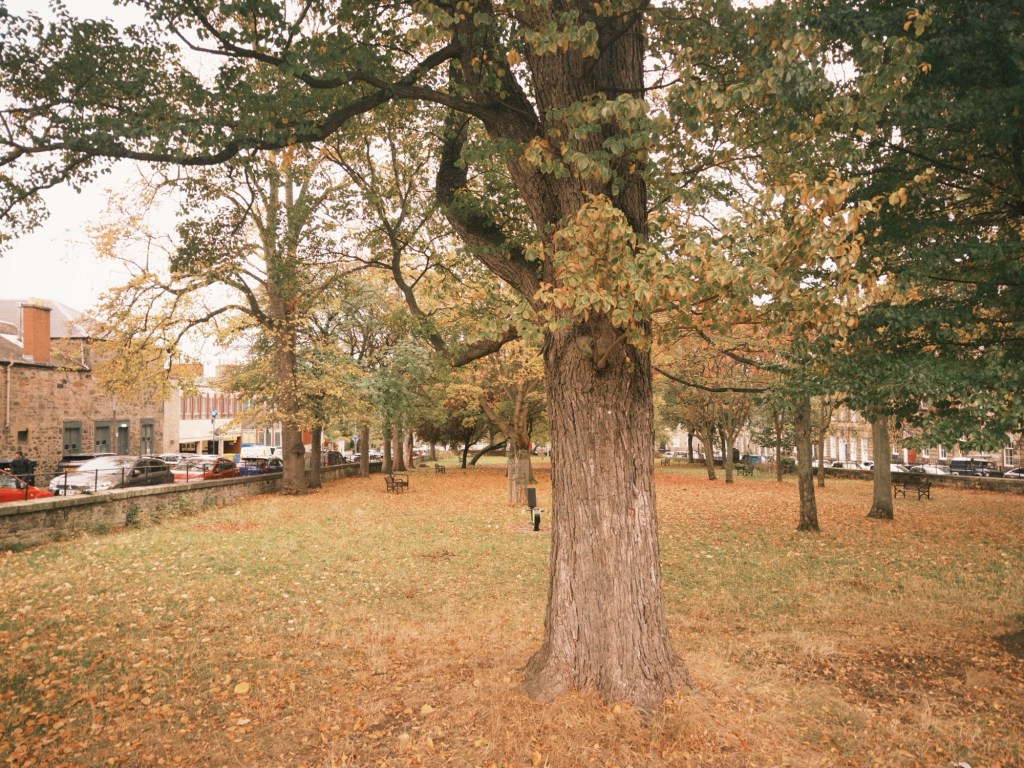
I saw her here right in this garden in Edinburgh. The air was soft and cool and every corner of this place whispered of something ancient and tender. The leaves had fallen quiet under the weight of autumn. The flowers were tired. Even the sun seemed unsure of its warmth. But then there was her. Standing there like the last piece of summer that refused to fade.
She bent down and touched a leaf that had turned brown, brittle, almost gone. I remember holding my breath as if I knew something was about to happen. Her fingers brushed against it so gently that even the wind paused. And in that stillness I saw it. The leaf shimmered for the smallest second, and the green came back to life. It was as if spring had found a way to bloom through her touch.
Her eyes were the kind you do not just look at, you fall into them and never really climb back out. They had that colour of honey mixed with dusk. A warmth that holds you without asking. A light that hurts and heals all at once. When she looked up the whole garden changed its breath. The world seemed to tilt toward her, as if everything in it was trying to get just a little closer.
The curls in her hair caught the light like they were made of it. They fell freely, the way music spills from an open window on a quiet street. I remember thinking that even if time stopped right there it would still not be enough to hold her beauty. There was something endlessly alive about her, something that refused to belong to just one moment.
And I, standing there like a fool, felt the season inside me change too. Everything cold began to melt. Everything lost began to return. I think that is what love does. It takes your dying autumns and quietly turns them into spring.
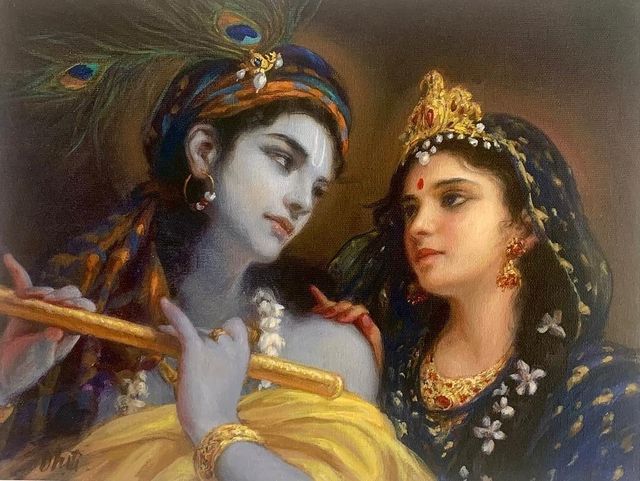
“O woman with desire, place on this patch of flower-strewn floor your lotus foot, And let your foot through beauty win, To me who am the Lord of All, O be attached, now always yours”
Krishna to Radha
When Krishna left for Mathura, the mind of Srimati Radharani was completely disrupted. She became almost mad because of the extreme separation from Krishna and experienced great mental pain and agitation, which caused Her to drown in various sorts of mental speculation in the river of anxiety.
She (Radharani) thought, ‘Now I am going to die, and when I die, Kṛṣṇa will surely come back to see Me again. But when He hears of My death from the people of Vṛndāvana, He will certainly be very unhappy. Therefore I shall not die.’
luṭhati ca bhuvi rādhā kampitāṅgī murāre viṣama-viraha-khedodgāri-vibhrānta-cittā
Uddhava said to Lord Kṛṣṇa, “My dear Kṛṣṇa, all the gopīs are so afflicted by Your absence that they have become almost mad. O Murāri, at home Śrīmatī Rādhārāṇī laughs unnecessarily and, like a madwoman, inquires about You from every entity without distinction, even from the stones. She rolls on the ground, unable to bear the agony of Your absence.” – Sri Ujjvala Nilamani 15.175
Radharani would madly talk (Pralāpa) as follows
kva nanda-kula-candramāḥ kva śikhi-candra-kālaṅkṛtiḥ kva mandra-muralī-ravaḥ kva nu surendra-nīla-dyutiḥ kva rāsa-rasa-tāṇḍavī kva sakhi jīva-rakṣauṣadhir nidhir mama suhṛttamaḥ kva tava hanta hā dhig vidhiḥ
My dear friend, where is Kṛṣṇa, who is like the moon rising from the ocean of Mahārāja Nanda’s dynasty? Where is Kṛṣṇa, His head decorated with a peacock feather? Where is He? Where is Kṛṣṇa, whose flute produces such a deep sound? Oh, where is Kṛṣṇa, whose bodily luster is like the luster of the blue indranīla jewel? Where is Kṛṣṇa, who is so expert in rāsa dancing? Oh, where is He, who can save My life? Kindly tell Me where to find Kṛṣṇa, the treasure of My life and best of My friends. Feeling separation from Him, I hereby condemn Providence, the shaper of My destiny.-Lalita-Madhava 3.25
Radharani won’t eat anything. Even sleep would desert Her. Thus, She had become very thin (Tānava). Uddhava thus describes Her condition to Krishna as follows
Consider the condition of the gopīs! Śrīmatī Rādhārāṇī especially is in a very painful condition because of separation from You. She has grown skinny, and Her bodily lustre is almost gone. Her heart is immersed in pain, and because She has given up eating, Her breasts have become black, as if diseased. Because of separation from You, all the gopīs, especially Rādhārāṇī, appear like dried-up water holes under the scorching heat of the sun. -Sri Ujjvala Nilamani 15.171
Observing the death-like condition of Srimati Radharani, Lalita Sakhi, wrote a strong letter to Krishna and chastised Him for staying in Mathura. She thus wrote as follows
aye rāsa-krīḍā-rasika mama sakhyaṁ nava-navā purā baddhā yena praṇaya-laharī hanta gahanā sa cen muktāpekṣas tvam asi dhig imāṁ tūla-śakalaṁ yad etasyā nāsā-nihitam idam adyāpi calati
Simply by dancing in the circle of the rāsa dance, You attracted Śrīmatī Rādhārāṇī’s love. Why are You now so indifferent to my dear friend Rādhārāṇī? She is lying nearly unconscious, thinking of Your pastimes. I shall determine whether She is alive by putting a cotton swab under Her nostrils, and if She is still living, I shall chastise Her.-Hamsa-duta [96]
Being greatly afflicted by the pain of separation from Krishna, Srimati Radharani, as if diseased, said to Lalita Sakhi as follows
uttāpī puṭa-pākato ’pi garala-grāmād api kṣobhaṇo dambholer api duḥsahaḥ kaṭur alaṁ hṛn-magna-śūlyād api tīvraḥ prauḍha-visūcikāni cayato ’py uccair mamāyaṁ balī marmāṇy adya bhinatti gokula-pater viśleṣa-janmā jvaraḥ
My dear Lalita, I cannot bear suffering the fever of separation from Kṛṣṇa, nor can I explain it to you. It is something like gold melting in an earthen pot. This fever produces more distress than poison, it is more piercing than Indra’s thunderbolt, more sharp than a spear plunged into the heart, and more horrifying than the last stage of cholera.- Lalita Madhava 3.24
When Radharani was feeling separation from Krishna, She would constantly chant Hare Krishna Mahamantra. Chanting of Mahamantra was Her only resort.
ekadā kṛṣṇa-virahād dhyāyantī priya-saṅgamam |
mano-bāṣpa-nirāsārthaṁ jalpatīdaṁ muhur muhuḥ ||
hare kṛṣṇa hare kṛṣṇa kṛṣṇa kṛṣṇa hare hare |
hare rāma hare rāma rāma rāma hare hare ||
Śrī Rādhā was feeling the pain of separation from Kṛṣṇa and was meditating on the reunion with Him. In order to rid Herself of the agony of separation She felt in His absence, She repeatedly began to chant the mahā-mantra: Hare Kṛṣṇa, Hare Kṛṣṇa, Kṛṣṇa Kṛṣṇa, Hare Hare/ Hare Rāma, Hare Rāma, Rāma Rāma, Hare Hare.
-Quoted in Sri-Harinamartha-ratna-dipika, Srila Raghunatha Dasa Goswami
When Srimati Radharani would faint, all the other gopis would chant the Hare Krishna Mahamantra in Her ears and would revive Her.

 Aaditya Bajpai