
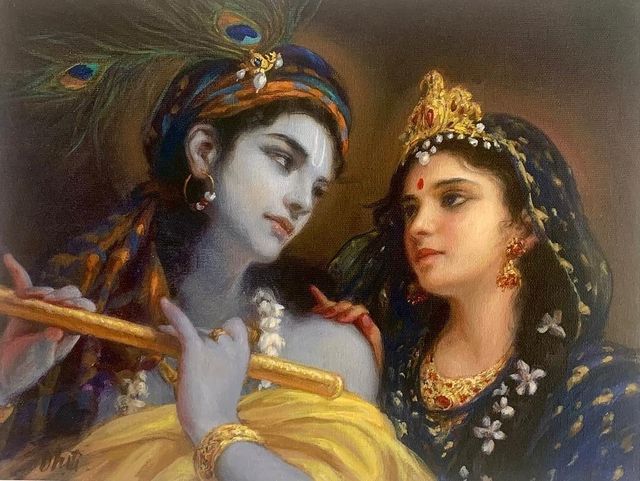
“O woman with desire, place on this patch of flower-strewn floor your lotus foot, And let your foot through beauty win, To me who am the Lord of All, O be attached, now always yours”
Krishna to Radha
When Krishna left for Mathura, the mind of Srimati Radharani was completely disrupted. She became almost mad because of the extreme separation from Krishna and experienced great mental pain and agitation, which caused Her to drown in various sorts of mental speculation in the river of anxiety.
She (Radharani) thought, ‘Now I am going to die, and when I die, Kṛṣṇa will surely come back to see Me again. But when He hears of My death from the people of Vṛndāvana, He will certainly be very unhappy. Therefore I shall not die.’
-Caitanya Caritamrta, Antya lila 1.53- Srila Prabhupada’s Purport
Describing the love in madness (Unmāda) of Srimati Radharani, Uddhava, after returning to Mathura from Vrindavana, spoke to Krishna as follows
bhramati bhavana-garbhe nirnimittaṁ hasantī prathayati tava vārtāṁ cetanācetaneṣu
luṭhati ca bhuvi rādhā kampitāṅgī murāre viṣama-viraha-khedodgāri-vibhrānta-cittā
Uddhava said to Lord Kṛṣṇa, “My dear Kṛṣṇa, all the gopīs are so afflicted by Your absence that they have become almost mad. O Murāri, at home Śrīmatī Rādhārāṇī laughs unnecessarily and, like a madwoman, inquires about You from every entity without distinction, even from the stones. She rolls on the ground, unable to bear the agony of Your absence.” – Sri Ujjvala Nilamani 15.175
Radharani would madly talk (Pralāpa) as follows
kva nanda-kula-candramāḥ kva śikhi-candra-kālaṅkṛtiḥ kva mandra-muralī-ravaḥ kva nu surendra-nīla-dyutiḥ
kva rāsa-rasa-tāṇḍavī kva sakhi jīva-rakṣauṣadhir nidhir mama suhṛttamaḥ kva tava hanta hā dhig vidhiḥMy dear friend, where is Kṛṣṇa, who is like the moon rising from the ocean of Mahārāja Nanda’s dynasty? Where is Kṛṣṇa, His head decorated with a peacock feather? Where is He? Where is Kṛṣṇa, whose flute produces such a deep sound? Oh, where is Kṛṣṇa, whose bodily luster is like the luster of the blue indranīla jewel? Where is Kṛṣṇa, who is so expert in rāsa dancing? Oh, where is He, who can save My life? Kindly tell Me where to find Kṛṣṇa, the treasure of My life and best of My friends. Feeling separation from Him, I hereby condemn Providence, the shaper of My destiny.-Lalita-Madhava 3.25
Radharani won’t eat anything. Even sleep would desert Her. Thus, She had become very thin (Tānava). Uddhava thus describes Her condition to Krishna as follows
udañcad-vaktrāmbhoruha-vikṛtir antaḥ-kulaṣitā sadāhārābhāva-glapita-kuca-kokā yadu-pate
viśuṣyantī rādhā tava viraha-tāpād anu-dinaṁ nidāghe kuly eva kraśima-paripākaṁ prathayatiConsider the condition of the gopīs! Śrīmatī Rādhārāṇī especially is in a very painful condition because of separation from You. She has grown skinny, and Her bodily lustre is almost gone. Her heart is immersed in pain, and because She has given up eating, Her breasts have become black, as if diseased. Because of separation from You, all the gopīs, especially Rādhārāṇī, appear like dried-up water holes under the scorching heat of the sun. -Sri Ujjvala Nilamani 15.171
Observing the death-like condition of Srimati Radharani, Lalita Sakhi, wrote a strong letter to Krishna and chastised Him for staying in Mathura. She thus wrote as follows
aye rāsa-krīḍā-rasika mama sakhyaṁ nava-navā purā baddhā yena praṇaya-laharī hanta gahanā
sa cen muktāpekṣas tvam asi dhig imāṁ tūla-śakalaṁ yad etasyā nāsā-nihitam idam adyāpi calatiSimply by dancing in the circle of the rāsa dance, You attracted Śrīmatī Rādhārāṇī’s love. Why are You now so indifferent to my dear friend Rādhārāṇī? She is lying nearly unconscious, thinking of Your pastimes. I shall determine whether She is alive by putting a cotton swab under Her nostrils, and if She is still living, I shall chastise Her.-Hamsa-duta [96]
Being greatly afflicted by the pain of separation from Krishna, Srimati Radharani, as if diseased, said to Lalita Sakhi as follows
uttāpī puṭa-pākato ’pi garala-grāmād api kṣobhaṇo dambholer api duḥsahaḥ kaṭur alaṁ hṛn-magna-śūlyād api
tīvraḥ prauḍha-visūcikāni cayato ’py uccair mamāyaṁ balī marmāṇy adya bhinatti gokula-pater viśleṣa-janmā jvaraḥMy dear Lalita, I cannot bear suffering the fever of separation from Kṛṣṇa, nor can I explain it to you. It is something like gold melting in an earthen pot. This fever produces more distress than poison, it is more piercing than Indra’s thunderbolt, more sharp than a spear plunged into the heart, and more horrifying than the last stage of cholera.- Lalita Madhava 3.24
When Radharani was feeling separation from Krishna, She would constantly chant Hare Krishna Mahamantra. Chanting of Mahamantra was Her only resort.
ekadā kṛṣṇa-virahād dhyāyantī priya-saṅgamam |
mano-bāṣpa-nirāsārthaṁ jalpatīdaṁ muhur muhuḥ ||
hare kṛṣṇa hare kṛṣṇa kṛṣṇa kṛṣṇa hare hare |
hare rāma hare rāma rāma rāma hare hare ||
Śrī Rādhā was feeling the pain of separation from Kṛṣṇa and was meditating on the reunion with Him. In order to rid Herself of the agony of separation She felt in His absence, She repeatedly began to chant the mahā-mantra: Hare Kṛṣṇa, Hare Kṛṣṇa, Kṛṣṇa Kṛṣṇa, Hare Hare/ Hare Rāma, Hare Rāma, Rāma Rāma, Hare Hare.
-Quoted in Sri-Harinamartha-ratna-dipika, Srila Raghunatha Dasa Goswami
When Srimati Radharani would faint, all the other gopis would chant the Hare Krishna Mahamantra in Her ears and would revive Her.
 Aaditya Bajpai