
William Shakespeare’s works are instrumental for the emergence of some of the most recognisable writings in the hallowed halls of English literature. In addition, William Shakespeare is credited with the development of a number of the most well-known literary techniques. He is responsible for several well-received works of human drama, comedy, and love sonnets, and the legacy of his work lives on to this day in the form of its effect on authors. The bulk of Shakespeare’s well-known plays and tales were written during the latter half of the 16th century. He spent many years savouring writing comedies and historical plays before he discovered his real love: creating tragic and gloomy dramas such as Hamlet and Macbeth.

Shakespeare’s initial plays are written in the conventional manner that was popular at the time. The use of extended metaphors, parables, and narcissisms, some of which were rather grandiose, was one of his primary storytelling approaches.[1] His writing often came out as verbose and pompous. Shakespeare’s first original comedy, “The Two Gentlemen of Verona”, which was written in 1590, demonstrates a literary style that is underdeveloped and erratic.
This article focusses on analysing and detailing in depth the writing style opted by Sir William Shakespeare in a vast majority of his work. This article aims to study the details in the lyrics produced by Sir William and the objective behind the same, by analysing the Iambic Pentameter and the age old poetic skill of Prosody.
The Iambic Pentameter
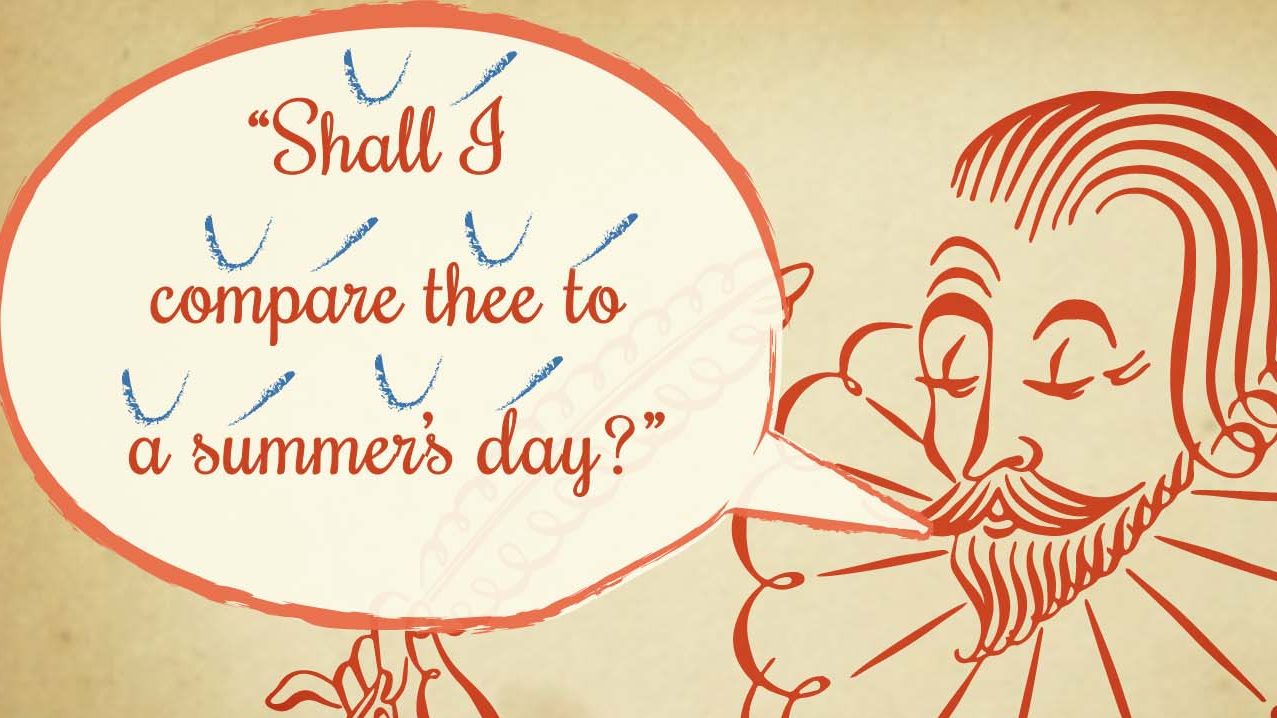
In a line of poetry, an ‘iamb’ is a foot or beat consisting of an unstressed syllable followed by a stressed syllable, or in another words, a short syllable followed by a longer one. The term ‘Penta’ means five, and hence pentameter simply means five meters. The Iambic Pentameter is a line of writing that consists of ten syllables in a specific patten of an unstressed syllable, followed by a stressed syllable.
Playwrights may mimic natural speech patterns in poetry by using iambic pentameter. The rhythm makes the text and the discussion more fluid and genuine. Iambic pentameter, in its simplest definition, is a metrical speaking rhythm indigenous to the English language. Shakespeare probably used iambic pentameter to mimic the pace of daily conversation in his plays, so that his audience would feel as if they were seeing themselves perform.[2]
The versatility of English iambic pentameter to absorb audible fluctuations in stress without disrupting the pattern’s abstract thread is one of its most often highlighted virtues. To imitate the great artists and writers Wimsatt and Beardsley: “It is practically impossible to write an English line that will not in some way buck against the meter. Insofar as it does approximate the condition of complete submission, it is most likely a tame line a weak line”.[3] It was pointed out that there would inevitably be, and that it was desired to have, some friction between the stress patterns of each line and the abstract pattern of meter.
The Artistic Skill of Prosody
One of the major traits of Sir William Shakespeare was his way of using words to manipulate the emotions of his audience, and regulate their attention.[4] This age-old poetic skill in ancient literature is termed as “Prosody”. Prosody is the study of the acoustic and rhythmic repercussions of words, most often in poetry yet often in prose. The word’s origin in ancient Greece suggests that it may have referred to either a song set to music or the way in which a syllable was stressed.[5]
A basic terminology under Prosody is the “iamb”, which means an unstressed syllable followed by a stressed syllable. This pair of syllables can be in a single word or spread across two. Let us take an example of the above from the piece by Lord Byron, titled “She Walks in Beauty”.
“She walks in beauty like the night
Of Cloudless clines and starry skies;”
Now, in Shakespeare’s use of Iambic Pentameter, you can see how rhythmic complexity is building, as each iamb is one part of a larger structure. For example: Refer to this extract from Shakespeare’s “Much Ado About Nothing” –
“What fire is in mine ears? Can this be true?
Stand I condemned for pride and scorn so much?
Contempt, farewell, and maiden pride, adieu!
No glory lives behind the back of such.”
It’s the paradigm that Shakespeare (and the vast majority of English poets since Chaucer) preserved. Because it’s easy to read, resonates in your consciousness, and facilitates you to get into a rhythm.
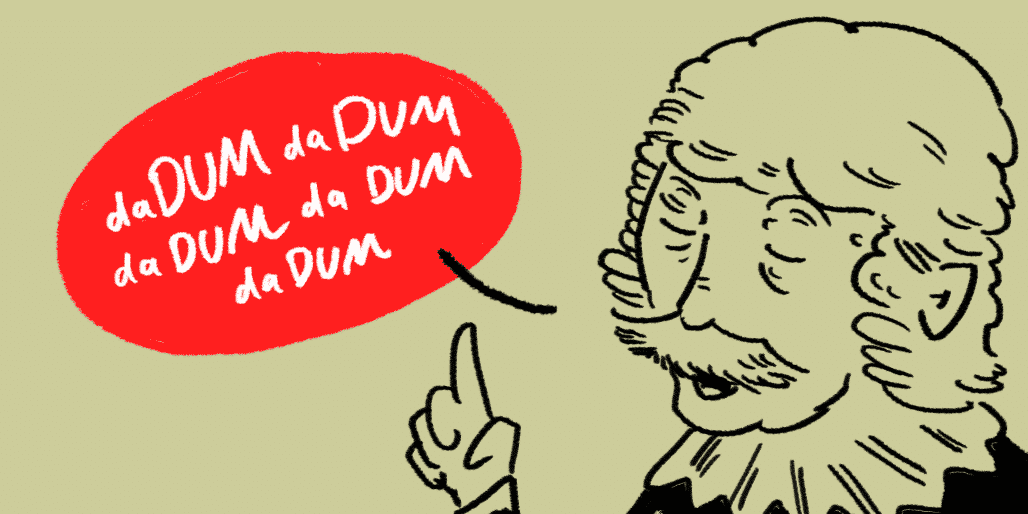
Keeping in mind the above explained “iambic rhythm”, read the following excerpt from King Lear –
“And my poor fool is hang’d! No, no, no life!
Why should a dog, a horse, a rat, have life,
and thou no breath at all? Thou’lt come no more,
never, never, never, never, never”
Now here in the above-mentioned excerpt, if you keep emphasis on the “never, never” then this is something called a “trochee”. The trochee is the opposite of the iamb; it’s a stressed syllable followed by unstressed (DA-dum). You can’t read it like an iamb; it doesn’t work.
For the same, refer to this excerpt from Macbeth, wherein Shakespeare uses ‘trochaic tetrameter’ as the main poetic meter, which basically means a line of four trochaic feet. In classical meter, a trochee is a foot with an elongated first syllable and a shorter second syllable; in contemporary English poetry, a trochee is a foot with a stressed first syllable and an unstressed second syllable. In classical meter, a line in tetrameter has four Metra, with each Metron consisting of two trochees for a total of eight trochees. A line containing four trochees in the contemporary meter.[6]
“Double, double toil and trouble;
Fire burn and caldron bubble.”
That concludes our discussion of the trochee and the iamb. You can see how the two flows are distinct from one another. Both of these things are referred to as “metrical feet”, which are literally units of rhythm. Poets rely on linguistic foundations akin to this as the primary source of sustenance and inspiration for their work. But those two things aren’t necessarily incompatible with one another. Shakespeare often blended the iamb and trochee (or, indeed, other metrical feet) to manage the tempo at which we speak or read his works.
Now keep all the above discussion in mind, and read the following excerpt which is the Macbeth’s final soliloquy –
Tomorrow, and tomorrow, and tomorrow,
Creeps in this petty pace from day to day,
To the last syllable of recorded time;
And all our yesterdays have lighted fools
The way to dusty death. Out, out, brief candle!
Life’s but a walking shadow, a poor player,
That struts and frets his hour upon the stage,
And then is heard no more. It is a tale
Told by an idiot, full of sound and fury,
Signifying nothing.
There’s a lot happening here, but the alternating iamb and trochee rhythms will stand out to you the most. You’ll find yourself in a groove, moving swiftly down a string of iambs or trochees, only to come to a standstill as the meter changes. Like being propelled forward by a force you can’t see while you read. This is something Shakespeare did throughout his strenuous episodes. The speed may be slowed and kept under control by combining metrical feet, which causes the speaker to accentuate certain words.[7]
“Tomorrow, and tomorrow, and tomorrow”, is an awkward, slow beginning. It drags on, dovetailing with Macbeth’s meaning.
We hit a good run here:
“And all our yesterdays have lighted fools
The way to dusty death”.
But then:
“Out, out, brief candle!”
We are wrenched away from the flow – almost like a train of thought – interrupted by this sudden, formless shout. Macbeth’s despair comes alive.
We pick up pace again with:
“That struts and frets his hour upon the stage,
And then is heard no more”.
But then the rhythmic flow starts to go awry. It moves from poetic meter to mere speech, from order to chaos, and ends with:
“Signifying nothing”. The words land.
Conclusion
This is prosody, the rhythmic use of language. Shakespeare had complete command of this unseen influence, which directs the feelings and focus of both the presenter and the receiver.
Shakespeare’s metrical changes, including crescendoing counterpoint, intertwining lines, and everything else, seldom, if ever, transmit meaningful semantic detail to audiences. However, they do provide for a stimulating mental setting, one in which the mind is continually prompted to react to novel input. Substantially unharnessed metrical patterns make up this setting; they don’t provide encoded signals, but they do constitute an autonomous order with their own unique cognitive demands and rewards.
To some extent, Shakespeare is responsible for shaping contemporary Western language and etiquette, which may explain why Huxley made him the antagonist of Brave New World. His greatness lies in the fact that he skilfully incorporated the themes, motifs, allegories, and metaphors of his many sources, notably his Greek and Latin heroes like Seneca and Ovid, into his poetry and reworked them to create something entirely new.
[1] Mark Womack, Shakespearean Prosody Unbound, 45 TEXAS STUDIES IN LITERATURE AND LANGUAGE 1, 15.
[5] X supra note 4.
[6] X supra note 4, 18.
[7] X supra note 5.
[2] Philip C. McGuire, Shakespeare’s Non-Shakespearian Sonnets, 38 SHAKESPEARE QUARTERLY 304, 308.
[3] William K. Wimsatt & Monroe C. Beardsley, The Concept of Meter: An Exercise in Abstraction, 74 PMLA 585, 590.
[4] Donald Neil Friesner, William Shakespeare, Conservative, 20 SHAKESPEARE QUARTERLY 165, 167.
Authored By: Aaditya Bajpai, Student, Maharashtra National Law University Nagpur
 Aaditya Bajpai